
School holiday camp bookings are the registrations, payments, consents and daily attendance records a club collects when it runs a day program for children during school holidays. Tennis centres, football clubs, multi-sport venues and academies across Australia run these camps four times a year, usually as five-day programs from around 9am to 3pm.
A camp looks simple from the outside. Inside, it is one of the busiest weeks a club runs: dozens of children on site for six hours, a different mix of families each day, medical details that coaches must know, and money that has to be collected before anyone walks through the gate. This guide covers how to set prices, cap numbers, design the registration form, run each day, and handle refunds, plus where Child Care Subsidy fits and where it does not.
- How do sports clubs run school holiday camps in Australia?
- How should a holiday camp be priced: per day or per week?
- How many children per coach should a holiday camp take?
- What should a holiday camp registration form collect?
- How do you run sign-in, coach rosters and wet weather plans?
- What cancellation, refund and Child Care Subsidy rules apply?
- What are the next steps for your next holiday camp?
How do sports clubs run school holiday camps in Australia?
Most clubs run holiday camps as day programs for primary-aged children, sold by the day or the full week, with bookings and payment taken online before the holidays start. The club sets the dates, ages, capacity, coach ratio and refund policy, then runs each day from a roll.
The typical format is consistent across sports. A camp runs Monday to Friday, often in both weeks of the holidays, from 9am to 3pm with an optional early drop-off or late pickup. Children are grouped by age or ability. The morning is skills, the middle of the day is lunch and games, and the afternoon is match play or a mini tournament.
Where clubs differ is in how they handle the admin. Some still take bookings by email and bank transfer, then chase forms in the week before. Others publish the camp on their website with online booking, so a family books days, completes the medical and consent questions and pays by card in one sitting. The second approach is the only one that scales past twenty children without a front desk working every evening.
A holiday camp also brings in families who have never set foot in the club. That makes it one of the best sources of new term enrolments, provided the club captures clean contact details and follows up after the camp. Venues running several sports, such as multi-sport centres, can use one camp to introduce children to programs they did not know the club offered.
A holiday camp is a short, high-volume program, so registration, payment and consent must be finished online before day one.
Capacity is set by courts, coaches and the club's own ratio policy, and it should be enforced by the booking system.
Most sport camps are not approved child care, so families cannot claim Child Care Subsidy for them.
How should a holiday camp be priced: per day or per week?
Offer both. Sell single days at a higher daily rate and the full week at a discount of roughly 10 to 15 percent, so the week costs about four and a half days. Add a time-limited early-bird rate and a sibling discount, and keep the rules for combining them simple.
Single days matter because working families build holiday care from several sources: a grandparent on Monday, a camp on Tuesday to Thursday, leave on Friday. A club that only sells full weeks loses those families. Full weeks matter because they let coaches run a program that builds across five days, and they give the club its numbers early.
Families pick the days that fit work and other holiday plans.
Fills gaps and suits younger or first-time campers.
Numbers change daily, so coach rosters are harder to set.
Higher price per day covers the extra admin and risk of empty spots.
One payment covers all five days of the camp.
Lets coaches run a program that builds from Monday to Friday.
Numbers are known early, so rosters and equipment can be locked in.
Lower price per day rewards the commitment.
Early-bird pricing works best with a hard date. A typical rule is 10 percent off the full-week price for bookings paid in full three weeks before the camp. It brings bookings forward, which is exactly when the club needs to know how many coaches to roster. Keep the early-bird to full weeks only, or it becomes a permanent discount on every day place.
Sibling discounts are common and families expect them. Apply them to the second and later children, at a flat percentage, and decide in advance whether they stack with the early-bird rate. Many clubs allow both but cap the combined discount, for example at 20 percent. Whatever the rule, the booking system should apply it automatically so the front desk is never asked to work it out by hand.
Worked example (illustrative figures). A suburban tennis club runs a five-day camp in the January holidays, 9am to 3pm, for children aged 5 to 12. It has six courts and caps the camp at 32 children a day. It charges $75 for a single day and $330 for the full week, which is $66 a day. The early-bird rate is 10 percent off the full week, or $297, for bookings paid three weeks out. Second and later siblings get 10 percent off.
By the start of the camp, 10 children are booked on the early-bird week ($2,970), 12 on the standard week ($3,960), and 38 single days are sold across the five days at $75 ($2,850). Gross takings are $9,780. If the club is registered for GST and its prices include GST, that is about $8,890 before GST. Four coaches for 6.5 hours a day over five days is 130 hours. At an illustrative loaded cost of $45 an hour, wages come to $5,850, leaving roughly $3,040 to cover courts, equipment, insurance, card fees and the head coach's planning time.
The example shows two things. The margin on a camp is real but thin, so every empty place and every refund matters. And the single-day places did a lot of work: without them, ten places a day would have sat empty. Change the numbers to suit your own venue, costs and local market.

How many children per coach should a holiday camp take?
For most sports camps, the child-to-coach ratio is a club policy, set by the club's risk assessment, insurer and sport's guidelines. Many clubs work to around one coach for every 8 to 12 children, with smaller groups for younger children and higher-risk activities.
It helps to be clear about what is regulation and what is not. Approved vacation care services operate under the National Quality Framework, which sets staffing requirements for those services. A sports camp that is not an approved child care service does not fall under those rules, so its ratio comes from its own policies. Rules such as Working with Children Checks still apply to coaches in every state and territory, and each state runs its own check.
A sensible ratio policy is written down and has three parts. A base ratio for the camp, such as 1:8 for children under 8 and 1:10 for older children. A rule that a second adult is always on site, so a coach dealing with an injured child never leaves a group alone. And a stricter ratio for activities near water, at height or off site. Check the policy with your insurer and your state sporting association before the first camp of the year.
Capacity is then the lowest of three limits: the courts or pitches available, the number of coaches you can roster at that ratio, and the club's first-aid and supervision cover. In the tennis example, six courts and four coaches at 1:8 both point to 32 children. The booking system should stop at that number for each day, and offer a waitlist after it, so the cap is enforced by the software instead of a staff member's memory.
Set the online capacity one or two places below your true limit for each day. Those held places cover a coach's own child, a late sibling request or a staff member calling in sick, without breaking your ratio on the morning.
What should a holiday camp registration form collect?
A holiday camp registration form should collect the child's details, parent contacts, emergency contacts, authorised pickups, medical conditions and allergies, medication and action plans, photo consent and acceptance of the camp terms and waiver. Everything a coach needs on the day should be captured before payment.
Medical and allergy questions deserve the most care. Ask direct questions with yes or no answers first: does the child have anaphylaxis, asthma, diabetes or epilepsy, and do they carry medication. Then ask for the action plan to be uploaded and the medication to be brought on day one, clearly labelled. A free-text box alone is how important details get missed.
Photo consent should be a clear yes or no, never assumed. Clubs love camp photos for social media, and many parents are happy to agree. Some are not, and for some children there are serious safety reasons. The answer needs to be visible to whoever holds the camera, which means it belongs on the roll, not in a filing cabinet.

A coach standing on court at 9.05am with thirty children needs to know, in seconds, which child carries an EpiPen, who cannot be photographed and who is allowed to collect each camper. If that information sits in an inbox or a paper form at the front desk, it is not there when it counts.
The waiver and camp terms should be short, in plain language, and accepted with a tick box at booking. Cover the activities involved, the club's refund and cancellation policy, behaviour expectations, the weather plan and permission for first aid. A waiver does not remove a club's duty of care, so it should be read alongside good supervision, not instead of it. Have it checked by your insurer or legal adviser once, then reuse it each holiday.
Returning families should not have to fill in everything again. If the details sit on the family's customer record, the form can show what was given last time and ask the parent to confirm or update it. That saves time and, more importantly, prompts a check on medical details that may have changed since the last camp.
How do you run sign-in, coach rosters and wet weather plans?
Run each camp day from a single roll that shows who is booked, their medical alerts, photo consent and authorised pickups. Coaches sign children in at drop-off and out at pickup, against that roll, and the roster is set from the confirmed numbers for each day.
Sign-in and sign-out is the part of the day with the most risk. Drop-off is crowded and parents are in a hurry. Pickup is worse, because a child should only leave with someone the parent has authorised. Record the time, the person and the staff member for every movement, and have a fixed process for late pickups and unknown adults. The detail is covered in our guide to child safety check-in and pickup procedures.
Rostering for camps is different from rostering weekly classes. Shifts are longer, often six or seven hours, and run five days in a row, and many camp coaches are casual staff or senior juniors. That brings in breaks, minimum engagement and overtime questions under the relevant award. Before setting camp shifts, read how to roster coaches under the Fitness Industry Award and check which award covers your staff.
Every camp needs a weather plan, written before the first booking is taken. For heat, set a temperature or heat-stress trigger at which the program moves to shade, indoors or shorter sessions, and build in water breaks and sun protection. For rain and storms, decide where children go, what they do, and at what point a day is called off. Tell families the plan at booking, so a wet Tuesday is a change of venue rather than a stream of phone calls.
Dates, times, ages, prices, discounts and the refund policy go live six to eight weeks before the holidays.
Families choose days or the full week, complete medical and consent details, and pay in one step.
Coaches are rostered once each day's bookings are known, using the club's ratio policy.
Coaches sign children in and out on the day's roll, with medical alerts and authorised pickups visible.
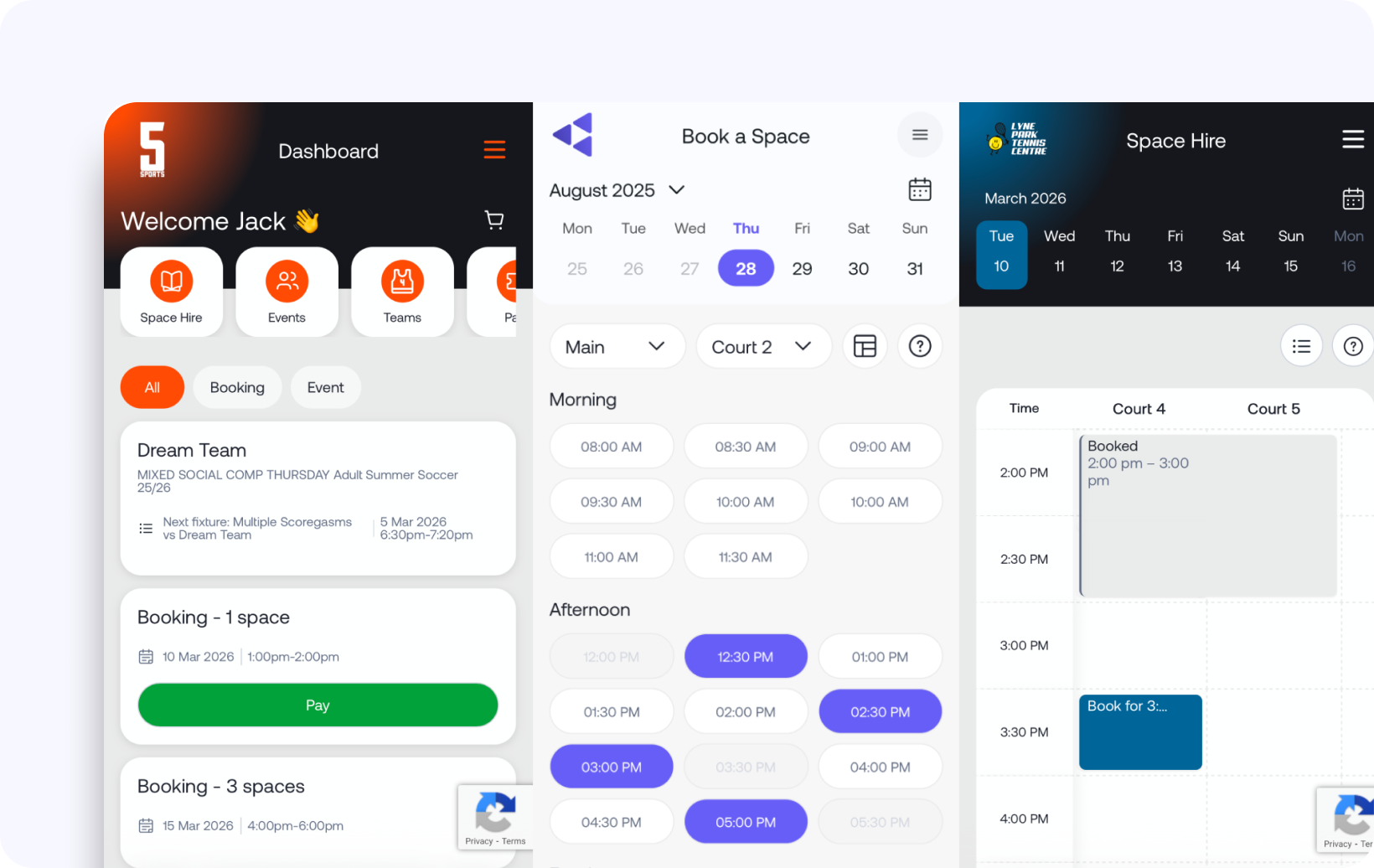
Clubs that run camps alongside term programs get the most from keeping both in one system. A camp booking can then sit on the same family record as term enrolments, with the same medical details, the same pickup list and the same payment history. Intrac, an Australian class & facility management system for sports facilities, schools and academies (founded 2000 by people running sports facilities since 1980), works this way, with a staff portal so coaches mark rolls on their phones.
Intrac takes camp bookings and payments online, holds medical and consent details on each family record, and gives coaches the day's roll on their phone.
Day or full-week places paid online by card when the family books.
Parents book siblings and update details in the customer dashboard.
No setup fees, local support, A+ security (OWASP).
What cancellation, refund and Child Care Subsidy rules apply?
Set a written cancellation and refund policy before bookings open, apply it consistently, and remember Australian Consumer Law still applies. Families can generally claim Child Care Subsidy only for approved child care, such as approved vacation care, so most sport holiday camps are not CCS-eligible.
A workable refund policy has a clear cut-off. A common pattern is a full refund or credit up to seven days before the camp, a credit only after that, and no refund for a day missed without notice. Medical certificates usually earn a credit for the missed days. If the club cancels a day, for weather or any other reason, families should get a refund or a credit for that day, whichever the policy promises. The principles are the same as for term programs, covered in make-up lesson and cancellation policies.
Credits suit both sides when the club runs camps every holiday. The family keeps the value, and the club keeps the money and the relationship. Make credits easy to use online at the next booking, and give them an expiry date that is long enough to be fair, such as twelve months.
Child Care Subsidy is the question clubs are asked most often, and the answer depends on approval. CCS is paid only for care at a service approved by the Australian Government, and Outside School Hours Care, which includes vacation care, is one of the approved care types (Services Australia). The Department of Education lists the four service types that can administer CCS (Department of Education).
For a sports club, that means a holiday camp is not CCS-eligible just because it looks after children during the holidays. Unless the club, or a partner running the program, is an approved vacation care service, families pay the full fee. Becoming approved is a significant step, with its own standards, staffing rules and reporting, and few sports clubs take it on. Say clearly on the booking page whether the camp is CCS-approved, so families are not surprised at checkout.
What are the next steps for your next holiday camp?
Start with the decisions: dates, ages, daily capacity, ratio policy, prices, discounts and the refund and weather rules. Write them on one page. Then set up online booking with the medical, consent and waiver questions built in, and open bookings six to eight weeks before the holidays.
Next, plan the days. Draft the program, build the coach roster from the early numbers, and brief coaches on the roll, the sign-in and sign-out process and the medical alerts for their group. Confirm first-aid cover and that every coach's Working with Children Check is current.
Finally, plan the follow-up before the camp ends. Every camp family who is new to the club should get an offer for the next term's program within a week, while the camp is still fresh. Track how many convert. Over a year of holiday camps, that number often matters more than the camp margin itself. When you are ready to see how online camp bookings could run at your venue, book a demo and bring your last camp's numbers.