A make-up lesson and cancellation policy actually works when it sets one clear notice period, treats illness differently from simple unavailability, gives make-up credits a fixed expiry, and is given to every family at enrolment rather than explained for the first time mid-dispute. Intrac can enforce all four of those rules automatically once you've written them down.
This is for swim school and sports program owners who are fielding the same make-up and refund arguments every week and want a policy that staff can apply consistently without escalating every call to the manager. Below is what the policy should actually say, section by section.
Why vague policies create the most disputes
A policy that says "make-ups available at the discretion of management" isn't a policy, it's an invitation to argue. Every exception a staff member grants becomes the precedent the next parent quotes back at you, and every refusal without a written reason feels arbitrary to the family on the other end of it.
The fix isn't a longer policy. It's a specific one: exact notice periods, exact credit windows, and exact rules for what counts as illness versus a missed session. Specific rules, applied the same way every time, are what actually stop disputes, not more customer service training for the front desk.
- Write the policy once, in plain language, and apply it the same way to every family.
- Separate the rules for illness and emergencies from the rules for simply not being able to attend.
- Put a number on every vague word: how many days' notice, how many weeks before a credit expires.
- Specific, consistently applied rules prevent more disputes than discretion does.
- Staff need a policy they can quote, not a judgement call they have to make.
- Every vague term in your current policy is a future argument.
Illness and weather vs simple unavailability
Families accept a policy far more readily when it distinguishes between circumstances outside their control and a simple scheduling clash. Illness, injury and facility closures (a lightning delay, a pool closure for contamination) sit in one bucket. Being double-booked with a birthday party sits in another.
A common pattern is to offer a make-up credit for illness and facility-caused cancellations with minimal notice required, while requiring proper notice for a simple unavailability to qualify for a credit at all. This isn't about punishing families. It's about making the rule predictable enough that nobody needs to argue their case.
Setting a fair notice period
The notice period is the single most-tested part of any policy, so it needs to be unambiguous: a specific number of hours or days before the session, stated the same way everywhere a family might read it: enrolment form, booking confirmation, and the app.
What counts as "reasonable" depends on your own program and cancellation lead times, not a borrowed number from another industry. A tennis clinic that can backfill a casual spot same-day can afford a shorter notice period than a swim class with a waitlist that needs 24 hours to confirm the next family.

Make-up credit expiry and class restrictions
A make-up credit without an expiry date never actually gets used. It sits on an account for a year, then becomes a refund argument when the family finally leaves. Give every credit a clear expiry, stated when it's issued, so families know exactly how long they have to book the catch-up.
Decide up front whether a credit is restricted to the same class type (a swim credit for a swim class) or can be used more broadly. Restricting credits to equivalent classes protects your scheduling. A credit redeemed in an already-full unrelated class just creates a new capacity problem.
- Set an expiry window and state it on the credit itself, not just in a policy document nobody rereads.
- Decide whether credits are class-type specific or facility-wide, and apply that rule consistently.
- Let families see their own credit balance and expiry date without having to call and ask.
Communicating the policy at enrolment
The policy should be read and acknowledged before the first missed session, not explained for the first time during the argument about it. That means it belongs on the enrolment form itself, not buried in a terms-and-conditions link nobody opens.
Learn to Swim Vic sends automatic enrolment notices and lets families book make-up lessons online themselves. See their approach in our Learn to Swim Vic customer story. Putting the policy in front of families at the exact moment they enrol, and again when they book a make-up, removes most of the confusion that leads to disputes.
Put the notice period and credit expiry in the booking confirmation email, not just the enrolment paperwork. That's the message families actually reread when they're deciding whether to cancel.
Automating credits instead of spreadsheets
Manually tracking who's owed a make-up, in what class, by what date, is where policies break down in practice. Not because the rule was wrong, but because nobody remembered to action it before the expiry passed.
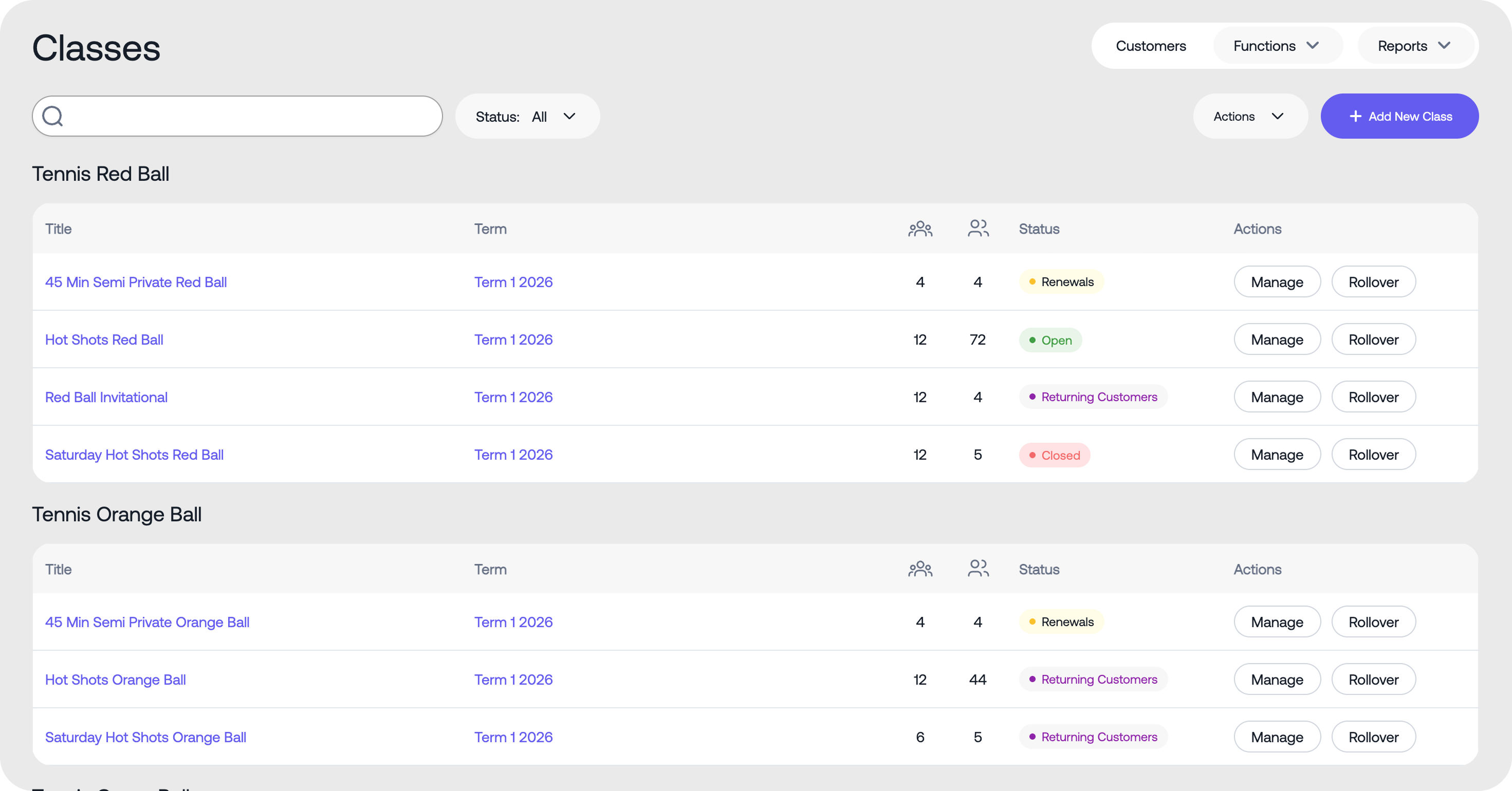
Intrac issues make-up credits automatically against your rules and lets families book their own catch-up session online, so staff aren't maintaining a spreadsheet of who's owed what. The credit, the expiry and the eligible class types are enforced by the system every time, not reinterpreted by whichever staff member answers the phone.

A policy that's automatically enforced is a policy that's actually fair, because every family gets the same rule regardless of who's on shift. Intrac applies your make-up rules the same way every time, so staff aren't making it up on the spot.
Intrac issues make-up credits against your rules and lets families book their own catch-up online, so staff stop tracking it by hand.
Credits are issued the moment a cancellation meets your policy rules.
Every credit carries its expiry date so nothing is used or lost by accident.
Families book their own make-up class online, against the eligible class types you set.
What Australian consumer law expects
Australian Consumer Law expects any cancellation and refund policy to be clear, available to customers before they pay, and applied as stated. It doesn't require a specific make-up or refund structure for class bookings, but it does expect you to honour the terms you've published. A policy you don't actually follow is worse than no policy at all.
Treat the policy as a document you'll be asked to produce, not just a page on your website. Keep it current, keep a record of when each family acknowledged it, and make sure staff are applying the version that's actually live.
It also helps to review the policy against real disputes rather than just in theory. If the same question keeps coming up, families asking for a credit after a public holiday closure the policy hadn't explicitly covered, for example, that's a sign the document needs a line added, not a sign staff should start using more discretion. Treat every repeated question from parents as a gap in the written policy, and close that gap in writing rather than case by case.
- Publish the policy where families see it before they pay, not after.
- Apply it exactly as written. Consistency is what protects you if a family disputes a decision.
- Review it yearly so it still matches how your programs actually run.
If you're rewriting your policy from scratch, start with the notice period and the credit expiry. Those two numbers resolve most disputes on their own. See how Sutherland Sharks FC and other Intrac customers handle bookings day to day in customer stories, explore Intrac's features, or book a demo to see make-up lessons running on your own rules.