
Class waitlist management is the process of recording families who want a place in a full class, deciding who gets the next spot, and offering it quickly when someone leaves. It applies to any program that runs fixed-size classes by level and time: swim schools, gymnastics clubs, dance studios and music schools.
A full class looks like success, but a spot that empties in week three and stays empty until next term is lost income and a family that went elsewhere. What separates a working waitlist from a frustrating one is how fast and how fairly the next name gets an offer.
- What is class waitlist management?
- Should a class waitlist be first-come or priority-based?
- How do automatic waitlist offers with time-limited holds work?
- How do you communicate waitlist position fairly?
- How should waitlists work at term rollover and for make-up lessons?
- How can waitlist length tell you when to open a new class?
- What are the next steps for improving your class waitlist?
What is class waitlist management?
Class waitlist management is the set of rules and routines that decide who is offered a vacant class spot, in what order, and how quickly. A good waitlist fills a cancelled place within days and leaves every waiting family understanding why the offer went where it did.
A waitlist is never one list. A family waiting for "swimming" is really waiting for a particular level, on particular days, at particular times, for a particular child. A Level 3 swimmer free only on Saturday mornings cannot fill a Tuesday 4pm Level 2 spot, however long they have waited. Useful waitlists are held against the exact class or a defined set of acceptable classes, never against the program as a whole.
Speed matters more in term-based programs than most operators realise. In a ten-week term, a spot that sits empty for two weeks has lost a fifth of its term revenue, and that time cannot be sold again. A waitlist that relies on someone at the desk noticing a cancellation, phoning down a paper list and leaving voicemails will usually take a week or more. A waitlist that sends a timed offer the same day usually fills the spot before the next lesson.
Fairness matters just as much. Parents talk, and in a gymnastics club or dance studio they talk at the same pickup door every week. One family who hears that a newer family got a spot first will assume favouritism unless the rules were written down and followed. Clear rules protect staff as much as families.
A waitlist is a promise of fair, fast access to the next spot in a specific class, level and time.
Speed matters because every week a mid-term spot sits empty is a lesson fee that cannot be recovered.
Written priority rules, timed offers and honest position updates keep a waitlist both fast and trusted.
Should a class waitlist be first-come or priority-based?
Most programs should use written priority rules with first-come, first-served as the tie-breaker within each tier. Pure first-come order is simple, but it ignores level fit, sibling families and current students who need to move up, so offers keep going to children who cannot take the spot.
The priority tiers that work for most swim, gymnastics, dance and music programs are short and predictable. Keep it to four or five tiers in plain language, published where families join the list. A typical order:
Current students moving level. A child already in the program who has been assessed ready for the next level comes first. Holding them back to serve a newcomer stalls their progression and is the fastest way to lose a loyal family.
Siblings of current students. Families with two or three children want them at the same venue, ideally in back-to-back time slots. A sibling tier keeps families together and reduces the number of separate trips they make each week.
Level and age fit. The spot must suit the child. A recreational gymnastics class for five to seven year olds is not an option for a ten year old, and a Grade 2 piano group is wrong for a beginner. Treat level fit as a filter applied before any tier: children who do not fit are skipped, never offered and refused.
Availability windows. Ask every waiting family to tick the days and times they can attend. A family who can do any weekday after 3:30pm should be offered more classes than a family who can only do Saturday at 9am. Wide availability is rewarded with faster offers, which is fair and easy to explain.
Join date. Within each tier, the family who joined first is offered first. This is the tie-breaker everyone understands.
Order is set by the date and time a family joined.
Simple to explain and hard to argue with.
Ignores level fit, so offers often go to the wrong child.
Current students wait behind strangers to move up.
Order is set by published tiers, then join date within each tier.
Needs a short policy that families can read before joining.
Matches offers to level, age and the times a family can attend.
Protects progression for children already in the program.
Avoid rules that cannot be checked. "Committed families" or "at the director's discretion" invite the favouritism complaint you are trying to prevent. If discretion is needed, for example for a child with additional needs who requires a specific instructor, write that exception down too, and apply it consistently.

How do automatic waitlist offers with time-limited holds work?
An automatic waitlist offer is sent to the next eligible family the moment a spot opens, and holds the spot for a set time, commonly 24 hours. If the family accepts and pays, they are enrolled. If they decline or the hold expires, the offer moves to the next family automatically.
The hold length should change with how soon the spot is needed. Early in a term, 24 hours is a sensible default. It gives working parents an evening to check calendars and reply. In the last few days before a class, shorten it to around four to eight hours, or the spot will cycle through two families and still be empty on the day. During a re-enrolment window, when families are juggling several activities, 48 hours is kinder and still fast.
Offers should go one family at a time for permanent term places. Sending one spot to ten families and taking the first reply rewards whoever checks their phone fastest and disappoints nine families within minutes. A broadcast offer is fine for a one-off make-up or casual spot, where fairness matters less and speed matters more.
The offer must also handle money. A family joining in week four should not pay for ten weeks. Pro-rata pricing based on lessons remaining is the usual approach, and it should be calculated automatically so the front desk is not doing arithmetic on the phone. The offer is only complete when the place is accepted and paid, because an accepted but unpaid spot is still effectively empty.
Put the expiry time in the offer itself, as a clock time and a day, such as "this spot is held for you until 6pm Tuesday". Families act on a deadline they can see. "Within 24 hours" gets read late at night and forgotten by morning.
When nobody accepts. Sometimes the whole eligible list declines or lets the hold expire. That is useful information and should not be ignored. First, widen the net: offer the spot to families waiting for neighbouring times or a level either side, if a coach confirms the child would fit. Second, offer it to current students as an extra weekly lesson or a permanent time change. Third, release it for public enrolment through the website. If it is late in the term and still empty, use it for make-up lessons until the term ends.
A list that repeatedly produces no takers is also a list that needs cleaning. Families who declined three offers in a row, or who have not opened an offer in a term, should be asked whether they still want to stay on. Keeping stale names inflates the list, slows every offer and gives you false demand data.
How do you communicate waitlist position fairly?
Communicate waitlist position honestly, in bands rather than exact numbers, and explain that priority rules can move a child up or down. Families mostly want to know whether a spot is likely this term, next term or later, and what they can do to improve their chances.
Exact positions cause trouble when priority rules are in use. A family told they are third on Monday may be fifth on Wednesday after two current students are assessed up a level. That is the policy working correctly, but it looks like queue-jumping from the outside. Bands avoid the problem: "next in line", "likely this term", "likely next term" and "unlikely within two terms". Each band should be based on how many spots that class usually turns over in a term.
Tell families what would help. The single most useful message a waiting family can receive is a list of similar classes with space right now. A parent waiting for Thursday 4:30pm Level 1 ballet may happily take Wednesday 4:00pm while staying on the list for Thursday. That fills a real spot today and keeps the original request alive.
Set expectations when they join. A short confirmation should state which classes the child is listed for, which priority tier they are in, how offers are sent, how long holds last, and how to update availability or leave the list. Families who can see and edit their own waitlist entries through a family portal ring the front desk far less often. Ask them to confirm they still want to stay on the list once a term, so the list stays accurate without anyone chasing it.
Be honest when the answer is "probably not". A Saturday morning beginner class with a list of twenty and a turnover of two a term will not have room this year. Saying so lets the family choose another time or program without resentment, and many come back later.
How should waitlists work at term rollover and for make-up lessons?
At term rollover, current students re-enrol first by a published deadline, then unclaimed places go to the waitlist in priority order, and only then to public enrolment. Make-up lessons should use temporary absences and must never take a permanent spot that a waiting family could fill.
Term rollover is the single biggest waitlist event of the year. Between terms, a predictable share of families leave: sport changes, school changes, moving house, or simply a break. If those places are released to the public before the waitlist is offered, the families who waited longest miss out and the policy loses credibility. The sequence should be fixed: current families confirm or release, the waitlist is offered, and the rest goes public. The re-enrolment window itself, and how to win back families who drift, is covered in re-enrolment and win-back campaigns.
Roll the waitlist forward with the term. A child waiting for Term 1 Level 2 may be ready for Level 3 by Term 2, or may no longer be free on Tuesdays. Ask families to confirm their entry during the re-enrolment window and update level and availability at the same time. Any entry that is not confirmed by the deadline can be moved to an inactive list rather than deleted, so a family who simply missed the email is not punished.
Make-up spots and permanent spots are different products. A make-up spot exists for one week because a regular student is away. A permanent spot exists because a student has left. Offering a permanent vacancy as a string of make-ups is tempting when make-up demand is high, but it leaves a waiting family without a place and loses the full term fee. The rule is simple: a permanent vacancy goes to the waitlist first, and only becomes make-up capacity if the waitlist cannot fill it. How many make-ups to allow and when, is covered in our guide to make-up lesson and cancellation policy.
The two systems should still talk to each other. If a class carries a make-up child every week because one regular student is always absent, that regular student may be about to leave. A conversation with that family before rollover can free a permanent spot cleanly and early.
How can waitlist length tell you when to open a new class?
Open a new class when a time slot's waitlist holds at least one full class of genuinely eligible children for two terms in a row, and you have the space and a qualified coach. A single long list for one term is often a seasonal spike that clears on its own.
Waitlist length is the most reliable demand data a class program has. Enquiries and website visits measure curiosity. A waitlist entry measures a family who has chosen a level, a time and a venue, and is willing to pay. Read it alongside class utilisation, because a long waitlist on Saturday mornings next to half-empty weekday classes is a timetable problem as much as a capacity problem. The method for reviewing fill rates by slot is in class utilisation and timetable review.
Participation data shows why children's programs feel this pressure. The Australian Sports Commission's AusPlay results, reported in November 2023, put swimming at nearly two million child participants and estimated 122,000 extra children took part in gymnastics that year (Australian Sports Commission). Demand at that scale lands unevenly, mostly on the same after-school and Saturday morning slots.

A waitlist is the only demand signal that comes from families who have already said yes. Read it term after term and it tells you which levels, days and times to add before you spend money on lane hire, floor space or another coach.
Worked example (illustrative figures). Consider a swim school running ten-week terms at $24 per lesson, so a full term costs a family $240. Classes in the junior levels hold four swimmers per instructor. On the Monday of week three, a family in the Saturday 9:00am Level 2 class gives notice that they are moving interstate.
That Saturday class has a waitlist of fourteen children. After filtering for Level 2 and Saturday morning availability, eight are eligible. The offer goes to the top family at 4:00pm Monday with a hold until 4:00pm Tuesday. They decline, because the child has started football. The second family lets the hold expire. The third family accepts on Wednesday morning and pays for the eight remaining lessons, $192 on a pro-rata basis. The child starts on Saturday, and the class never runs short.
Now look at the whole term. Suppose the school has twenty mid-term cancellations across its timetable, and timed offers fill sixteen of them within three days, each with an average of six lessons remaining. That is 96 lessons, or $2,304, that would otherwise have been lost, and sixteen families who started this term instead of looking elsewhere.
The same data tells the school what to build next. If the Saturday 9:00am Level 2 list has held eight or more eligible children for two terms, a new Saturday 8:15am Level 2 class of four is close to guaranteed full. At $240 per swimmer, two new classes of four add $1,920 a term in fees before instructor wages and pool costs, and they clear most of the list at once. Before committing, run the four checks below.
Count waiting children by level, day and time slot, with how many terms each slot has had a list.
Remove duplicates and children who would accept another time, then count the true unmet demand.
Check pool lanes, floor space or studio time, and a qualified coach, for the slot with the longest list.
Create the class and offer it to the waitlist in priority order before advertising it publicly.
Then offer the new class to the waitlist in priority order before advertising it publicly. Families who waited get first choice, and the class is usually full before anyone outside the list hears about it.
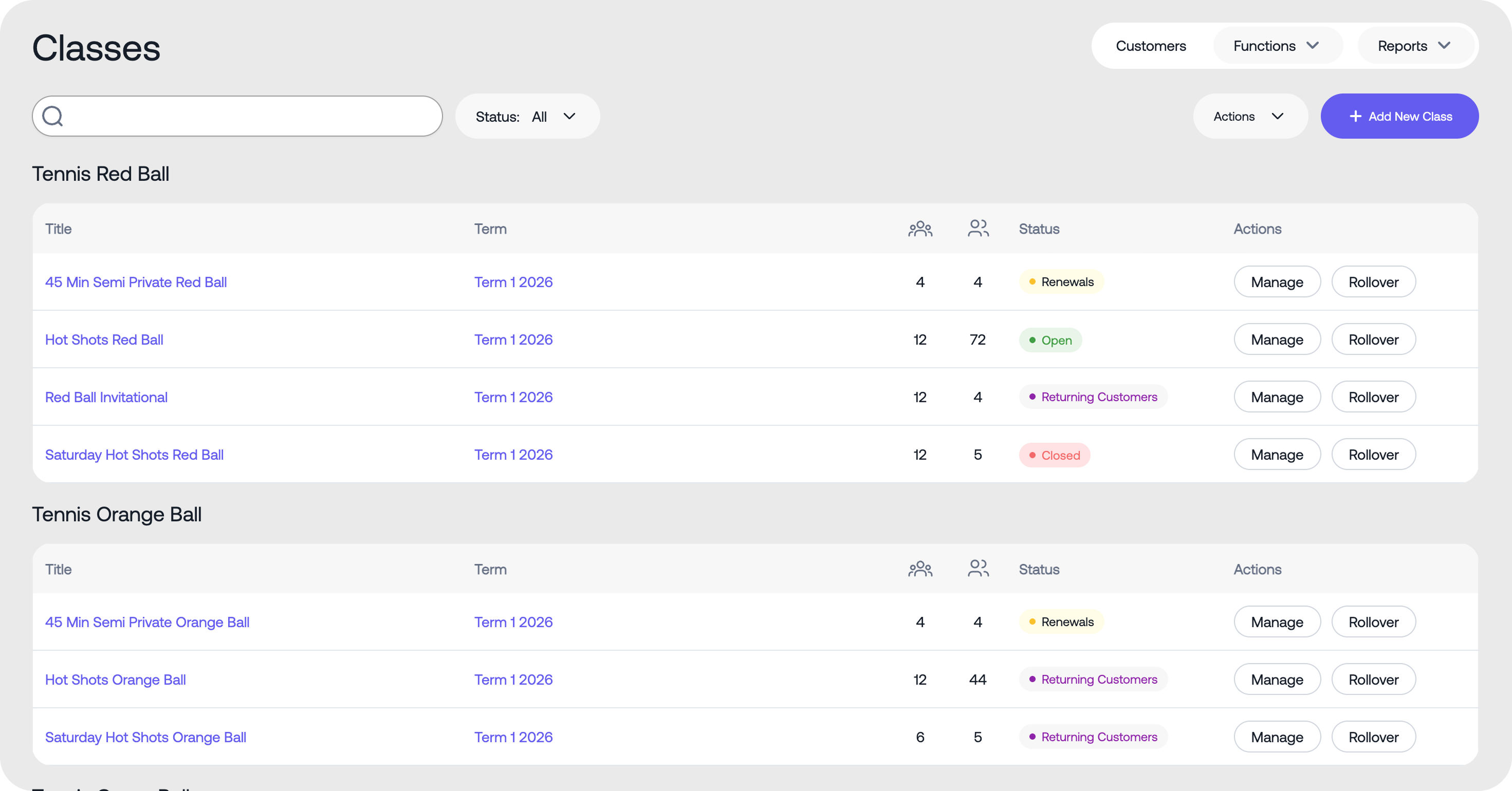
Running this as a routine is far easier when waitlists sit in the same system as class rolls, levels and enrolments. Intrac, an Australian class & facility management system for sports facilities, schools and academies, keeps all of these together, so a new class can be created and offered to the right families from the same records.
Intrac manages class rolls, levels and waitlists in one place, so a cancelled spot can be offered to the right child from the same screen the coach and front desk already use.
Waiting children are held against the class and level they need.
Families accept a place and pay through the customer dashboard.
Australian, local support, A+ security (OWASP).
What are the next steps for improving your class waitlist?
Start by writing a one-page waitlist policy: priority tiers, how offers are sent, hold length, what happens when nobody accepts, and how families update or leave the list. Then audit the current list, remove stale entries, and set one person responsible for each offer cycle until it is automated.
Next, measure two numbers every term: how many days a cancelled spot takes to fill, and how many spots were never filled. Those two figures show whether the process is working far better than the length of the list. If spots take more than a week to fill, fix the offer process first.
Then use the list for planning. Before each term's timetable review, export waitlist counts by level, day and time, and compare them with utilisation. Add classes where lists have stayed long for two terms, and move families toward times with space where they have not.
Finally, check whether your software can carry the routine for you: timed offers, pro-rata payment on acceptance, self-service updates through a customer dashboard, and waitlist reporting by class. If it cannot, that is worth fixing before next term's rollover. When you are ready to compare, book a demo and bring your real waitlist with you.