Re-enrolment, not new enquiries, is what actually drives revenue growth term to term for most swim schools and sports academies. A family that doesn't rebook is a bigger loss than a slow week of new sign-ups. Intrac helps facilities automate enrolment notices and surface who hasn't rebooked yet, so staff spend their time on follow-up calls rather than chasing paperwork.
This article is for facility managers and front-desk staff who run re-enrolment at the end of each term, whether that's a swim school, a tennis program or a multi-sport academy. It covers when to start outreach, how to segment families so the message actually fits them, what tends to move the needle versus what wastes staff time, and how to measure re-enrolment properly as its own number.
- Why re-enrolment matters more than new sign-ups
- When should re-enrolment outreach actually start?
- Automated reminders vs manual phone calls: what works for what
- Segmenting lapsed, at-risk and loyal families
- Using attendance data to personalise the conversation
- Incentives that don't train families to expect a discount
- Measuring re-enrolment as its own number
Why re-enrolment matters more than new sign-ups
A family that re-enrols term after term is worth more over time than any single new enquiry, and losing an existing family costs more to replace than it cost to keep them. New sign-ups still need an induction, a first lesson, a first invoice cycle. Facilities that focus marketing effort entirely on new leads while treating re-enrolment as something that "just happens" are leaving their most reliable revenue source to chance.
The practical shift is to treat re-enrolment as a managed process with its own timeline and owner, not an afterthought that staff get to once new enquiries are handled. That alone changes outcomes more than any single marketing tactic.
- Keeping an existing family costs less effort than replacing them with a new one.
- Re-enrolment should be a managed process with a clear owner, not a side task.
- Facilities that over-invest in new leads often under-invest in retention.
When should re-enrolment outreach actually start?
Families decide whether they're continuing well before the term actually ends, often in the back half of the current term, as school holidays, other activities and budgets come into view. Waiting until the last week of term to ask "are you coming back?" means you're competing with a decision many families have already made informally.
A practical rule of thumb is to open the re-enrolment window while there's still enough of the current term left for a family to feel they're confirming a continuing relationship, not scrambling to beat a deadline. Automatic enrolment notices sent at the right point in the term, the approach Learn to Swim Vic uses for its swim school in Heidelberg, keep this moving without relying on staff to remember the date.

Automated reminders vs manual phone calls: what works for what
Automated reminders are the right tool for loyal, engaged families who just need a nudge and a simple rebooking link. They're fast, consistent, and don't rely on staff remembering to send them. A phone call is the right tool for a family that's shown signs of disengaging, where a generic reminder is more likely to be ignored than acted on.
The mistake to avoid is using one tool for every family. Sending the same generic reminder to a family who's already missed several sessions wastes the message, while calling every single family individually when most just need a reminder wastes staff time that could go to the families who actually need a conversation.
- Automated reminders for families showing normal attendance and engagement.
- A personal call or message for families showing signs of disengagement.
- Don't apply either tool uniformly across your whole family base.
Segmenting lapsed, at-risk and loyal families
Not every family needs the same re-enrolment message. Loyal families who've rebooked every term for years need a quick, easy path to confirm again. Friction is the enemy here, not persuasion. At-risk families, who've shown a recent change in attendance or engagement, need a conversation that acknowledges that, not a generic reminder. Lapsed families who've already left need a different message again, focused on what's changed or what would bring them back, rather than assuming they simply forgot to rebook.
Treating these three groups the same with one broadcast message is the single most common re-enrolment mistake facilities make, and it's also the easiest one to fix once attendance data is actually visible to whoever's doing the outreach.
Before sending a single reminder, pull last term's attendance list and sort it into loyal, at-risk and lapsed in five minutes. The segmentation itself usually matters more than the wording of the message.
Using attendance data to personalise the conversation
A family that's missed the last three sessions and a family with perfect attendance shouldn't get the same re-enrolment call, even if both are technically "due to rebook". Attendance and progress data gives staff something real to talk about: a child who's progressing well toward the next swim level, or a player who's missed recent sessions because of a scheduling clash you might be able to solve.
This isn't about surveillance, it's about making the conversation useful to the family, not just a sales pitch. A quick note on progress or attendance turns a generic "are you coming back?" into a conversation that actually respects the relationship you've built over the term.

Families decide whether to continue well before term's end, often quietly. Intrac surfaces attendance and rebooking status so staff can reach out while there's still time to make a difference.
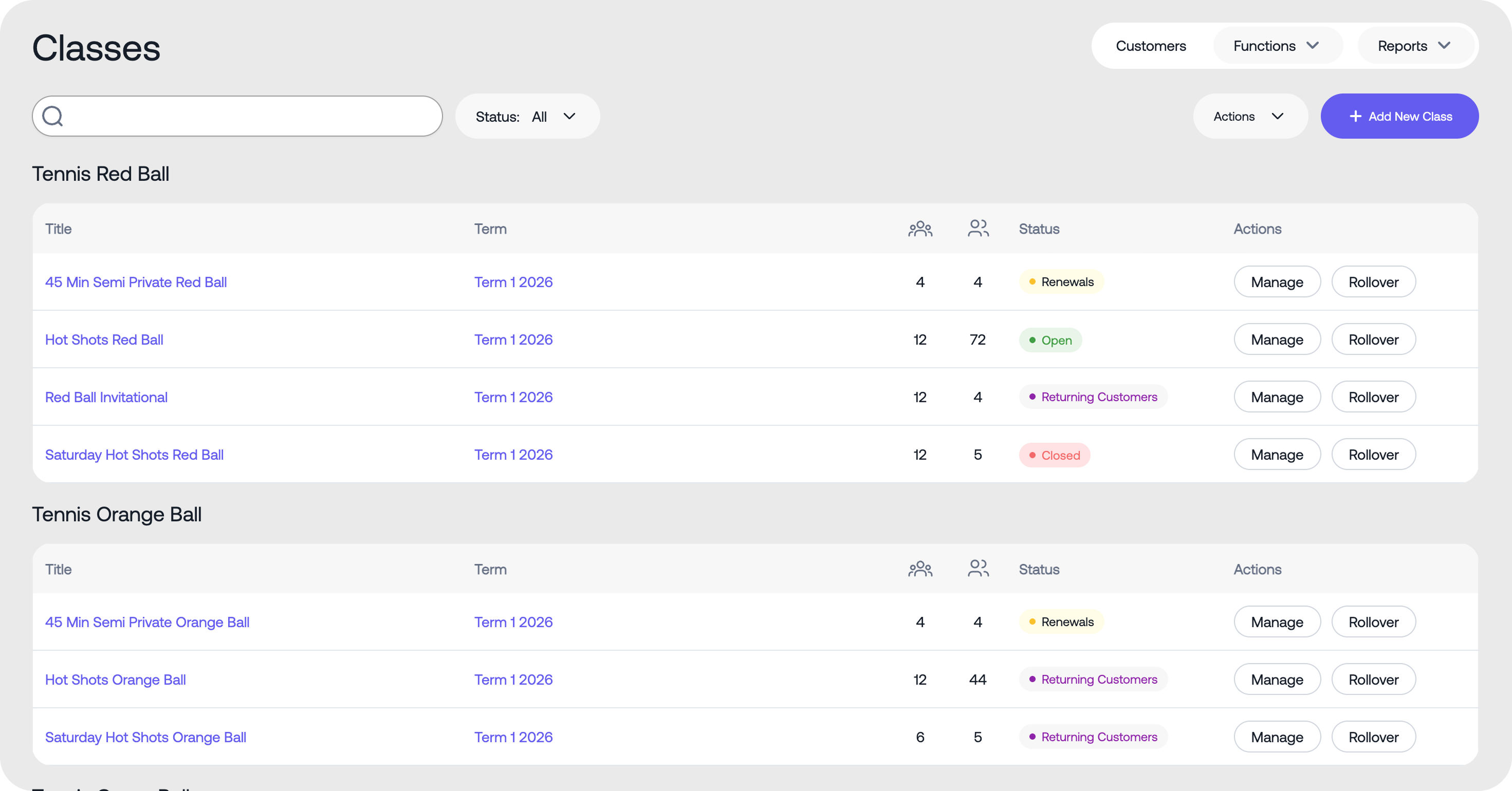
Intrac manages term rollover, sends automatic enrolment notices and reports on who hasn't rebooked, so re-enrolment runs as a process, not a scramble.
Notices go out at the right point in the term without staff needing to remember.
A clear report of lapsed and at-risk families, ready for follow-up.
Carry enrolments, credits and family details into the next term automatically.
Incentives that don't train families to expect a discount
A discount can win back a lapsed family once, but a facility that discounts every term teaches every family to wait for the discount before rebooking, which erodes margin without actually improving loyalty. The more durable lever is making the thing families already value easier to access: priority booking for the next level up, an easy transfer between locations or times, or simply removing friction from the rebooking process itself.
If you do use an incentive, reserve it for genuinely lapsed families you're trying to win back, not as a standing offer for everyone. Otherwise it stops being an incentive and becomes the expected price.
Measuring re-enrolment as its own number
Re-enrolment rate deserves its own measurement, separate from overall member or enrolment counts, because a flat total enrolment number can hide a shrinking base of loyal families replaced by a constant stream of new sign-ups. Measuring what share of last term's families actually rebooked tells you whether the program itself is retaining people, not just whether marketing is bringing new ones in.
- Start outreach while there's still meaningful time left in the current term.
- Match the channel, automated reminder or personal call, to how engaged the family currently is.
- Segment loyal, at-risk and lapsed families, and message each one differently.
- Track re-enrolment rate on its own, not blended into total enrolment numbers.
If your re-enrolment process still relies on a spreadsheet and someone's memory of who hasn't paid, it's worth seeing how this works end to end. Look at Intrac's class scheduling and term rollover under features, read how Learn to Swim Vic runs its enrolment notices, or book a demo to see your own term's rollover in action.