
Utilisation is the percentage of available places in a class that are actually booked, measured timeslot by timeslot, not averaged across your whole week. Intrac calculates this automatically from your booking data, so you can see which specific classes are carrying the timetable and which are quietly costing you money.
This is for owners and program managers at swim schools, tennis centres and multi-sport academies who suspect some classes aren't pulling their weight but have never sat down and proven it. Below is how to measure utilisation properly, what to do about the slots that fail, and how to rebalance a timetable without a mutiny from regular families.
What utilisation actually measures
Utilisation is simple on paper: bookings divided by capacity, for one class, in one timeslot. A 6-lane swim class with four kids booked in is running at a fraction of capacity even if the pool is busy all afternoon. A tennis clinic with eight players on a four-court roster is over capacity and probably turning people away.
The mistake most facilities make is looking at the room, not the class. A full car park and a buzzing front desk tell you nothing about whether Tuesday's 4:15pm intermediate group is worth running. You need the number for that specific class, every week, not a gut feeling from walking the floor.
- Capacity is the maximum places you've set for that class, not the physical room limit.
- Bookings should count confirmed enrolments only, not waitlist entries or casual trials that haven't converted.
- Utilisation needs to be tracked per class, per timeslot, per term, not blended into a single site-wide number.
- Utilisation is a per-class number, not a facility-wide vibe check.
- Track confirmed bookings against the capacity you actually set.
- A busy front desk doesn't mean every class is full.
Why a weekly average hides the real problem
If you average utilisation across the whole week, one packed Saturday morning swim block can mask three dying Tuesday afternoon classes. The average looks healthy. The business doesn't feel healthy, because payroll, pool heating and court lighting are all still being paid for those quiet Tuesday slots.
The fix is to look at a distribution, not a single figure. Rank every class by utilisation and look at both ends: the classes running hot that might need a second group, and the classes running cold that are quietly eating margin every week they continue unchanged.
Intrac's class list shows places, status (Open, Renewals, Closed) and bookings for every program and term side by side, so this comparison takes minutes rather than a spreadsheet export and a Friday afternoon.
Peak demand and the dead-slot trap
Dead slots happen when a class is scheduled where demand predictably isn't, not because the program is bad. A Wednesday 1pm class for school-age kids will almost always struggle, no matter how good the instructor is, because the audience is in school.
The trap is treating every dead slot the same way. Some should be cancelled outright. Others should be moved to a different audience entirely. A Wednesday 1pm slot can work well for an adults' program, a seniors' group, or a parent-and-toddler class that a 4:30pm slot can't accommodate because older kids own that time.

Knowing when a class stops paying for itself
A class pays for itself when the revenue from booked places covers the instructor's time, the space cost and a reasonable share of overheads, with something left over. You don't need a fixed industry number to know this. You need your own instructor pay rate, your own room cost, and your own fee for that class, worked through honestly.
Instructor cost is often the biggest lever, and it's governed by your award obligations. Under the Fitness Industry Award 2020, casual instructors and coaches at certain classification levels can be engaged for a minimum of one hour rather than the standard three-hour casual minimum, which materially changes the break-even maths for short specialty classes. Check your obligations against the Fair Work Fitness Industry Award page before you restructure rosters around this.
- Work out the real cost of running the class: wages, space, and a fair share of fixed overheads.
- Compare that to the fee revenue at current bookings, not at full capacity.
- If a class has been below that line for a full term, it needs a decision, not another term of hoping.
Turning waitlists into revenue
A waitlist on a full class is spare demand you haven't captured yet. Every name on it is a signal to either open a second group at that time, or to offer that family a seat the moment someone cancels, rather than letting the place sit empty for a week while admin catches up.
The common failure mode is a waitlist that's maintained on paper or in someone's head. By the time a spot opens and a staff member remembers to call around, the family has often enrolled somewhere else. Automating the offer, first in line gets notified first with a short window to confirm, closes that gap and protects revenue you'd otherwise write off as a cancellation.
Intrac manages waitlists automatically against class scheduling, so an offer goes out the moment a place opens and the class fills itself without a staff member chasing a phone list. Learn more about class scheduling with Intrac.
Rebalancing without upsetting regulars
The fastest way to lose goodwill is to shuffle a family's regular Tuesday slot without warning. Rebalancing has to be planned around term boundaries, not mid-term, and communicated as an improvement, not an inconvenience.
A common pattern is to protect existing bookings in a class you're closing down by offering first right of refusal on the replacement timeslot before it opens to new enrolments. That single step turns a potentially angry phone call into a family that feels looked after.
Before you cancel a struggling class, check whether it's the timeslot or the instructor pairing that's underperforming. Moving a popular coach into a dead slot sometimes fixes the problem without touching the timetable at all.
How often to review the timetable
A weekly glance at utilisation catches problems early. A class trending down two weeks running is worth a conversation before it's a pattern. A full termly review is where you make the bigger calls: which classes to retire, which to duplicate, and where instructor rosters need to move.
Doing both means you're never surprised by a term's results, and you're never making a big scheduling decision on stale data from two terms ago.

A timetable built on data instead of habit is the difference between a facility that grows term on term and one that's quietly subsidising its weakest classes. Intrac puts that data in front of you every week, not just at renewal time.
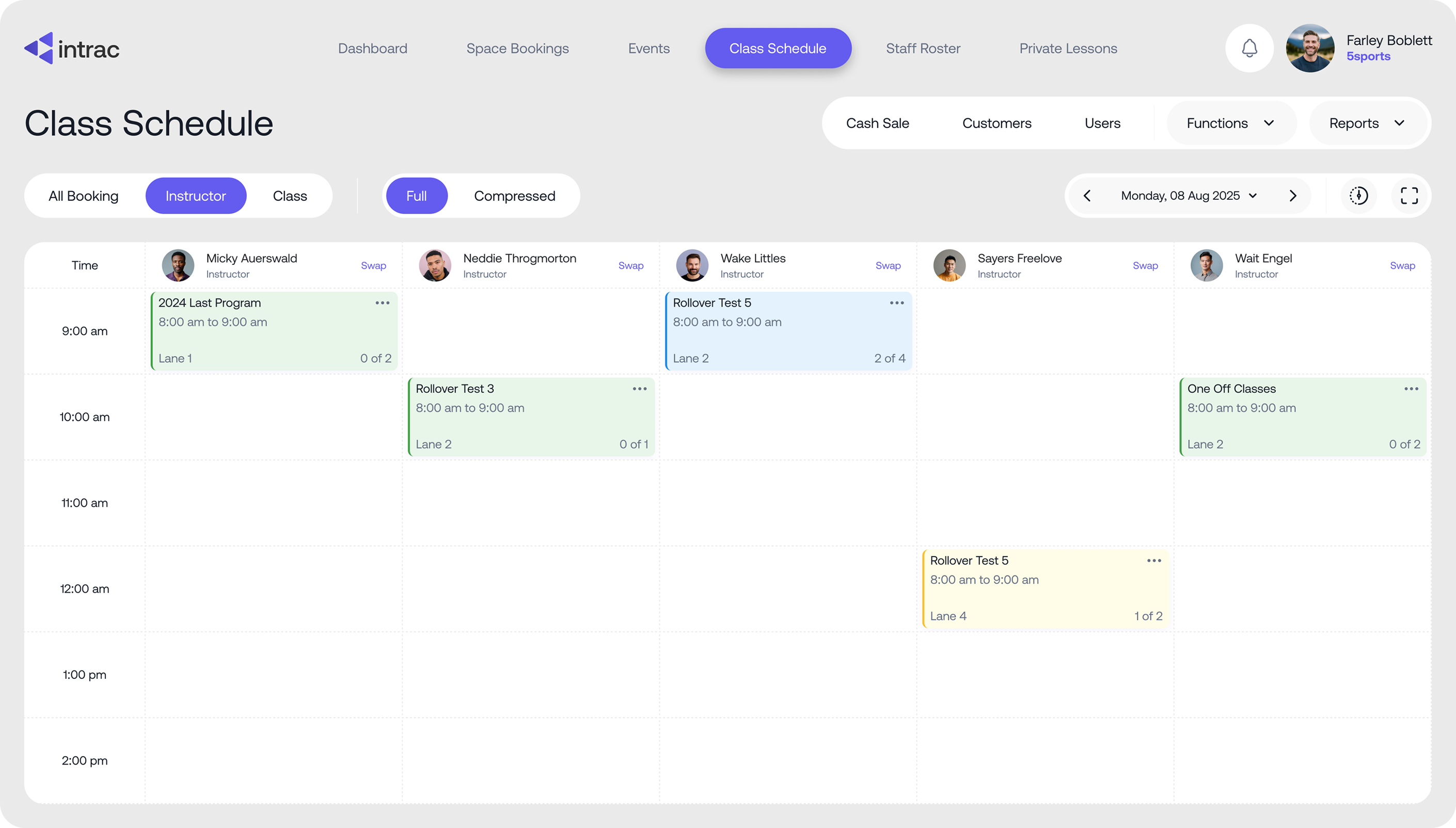
Intrac schedules classes by instructor, lane and class size, and automatically manages the waitlist queue behind every full class.
See bookings against capacity for every class and term at a glance.
A cancelled place is offered to the next family automatically, with no staff phone calls.
Move a coach between classes with a swap-coach button when a timeslot needs rebalancing.
Your next timetable review, step by step
Start small: pull utilisation for every class this week, rank it high to low, and flag anything that's been struggling for a full term. Then decide, class by class, whether the fix is the timeslot, the instructor, the audience, or the class itself.
- List every class with current bookings against capacity.
- Flag any class below a sustainable level for two terms running.
- Check whether a waitlist exists elsewhere that could fill the gap with a different offering.
- Plan any change to land at a term boundary, with existing families given first choice.
Facilities like Super Kids Sports run 50-plus programs across three locations on exactly this kind of visibility. See their approach in our Super Kids Sports customer story, or browse more examples in customer stories. If your timetable needs a proper review, book a demo and we'll show you what Intrac surfaces about your own classes.