
A round robin fixture is a competition draw in which every team plays every other team once, so the ladder at the end reflects the whole field rather than the luck of who drew whom. It is the standard format for social and junior competitions in futsal, netball, basketball, tennis, padel and indoor cricket, and it works for a six-team Tuesday night league as well as a forty-team junior carnival split into pools.
Building one by hand is simple in principle and fiddly in practice. The pairings take ten minutes. Making sure nobody plays at 8pm four weeks running, every team gets a fair share of home games, byes are spread evenly and a washed-out round can be absorbed without rewriting the season is where the hours go. This guide covers the formulas, the circle method with a full six-team example, court and time allocation, ladder points and tie-breakers, and what to do when the weather gets a vote.
- What is a round robin fixture and how many rounds does it need?
- When should you use a round robin, a double round robin, or pools and finals?
- How do you build a round robin draw with the circle method?
- How do you balance courts, timeslots and home and away games?
- How should ladder points and tie-breakers work?
- What happens with washouts, forfeits and rescheduling?
- What are the next steps for fixturing your next season?
What is a round robin fixture and how many rounds does it need?
With an even number of teams (n), a single round robin needs n minus 1 rounds, with n divided by 2 matches in each round and n(n minus 1) divided by 2 matches in total. With an odd number of teams, add a bye so the count becomes even, then apply the same formulas.
Six teams therefore need 5 rounds of 3 matches, 15 matches in all. Eight teams need 7 rounds of 4 matches, 28 in all. Ten teams need 9 rounds of 5 matches, 45 in all. Twelve teams need 11 rounds of 6 matches, 66 in all. The total grows much faster than the team count, which is why a competition that fits neatly into a school term at eight teams stops fitting at twelve.
Odd numbers work the same way once the bye is treated as a team. Seven teams plus a bye make eight slots, so the draw has 7 rounds. Each round has 4 pairings, but one of them is a team against the bye, so only 3 matches are actually played. That gives 21 matches in total, which is 7 times 6 divided by 2, and every team sits out exactly once.
The numbers matter before any names go on a draw. Count the playable weeks, subtract a week or two for finals and catch-ups, and check the result against n minus 1. If the rounds do not fit, change the format before registrations open.
There is no shortage of teams looking for a game. The Australian Sports Commission's AusPlay survey found nearly six million adults (26 per cent) played organised sport, and nearly 1.3 million children take part through a sports club or association (Australian Sports Commission). Most of them play in a fixture someone had to build.
Even n teams: n minus 1 rounds, n/2 matches per round, n(n minus 1)/2 matches in total.
Odd number of teams: add a bye, and every team sits out exactly once per round robin.
Check rounds against available weeks before registrations open, not after the draw is published.
When should you use a round robin, a double round robin, or pools and finals?
Use a single round robin when the season has at least n minus 1 playable weeks plus a buffer. Use a double round robin when there are roughly twice that many weeks. Switch to pools and finals when a full round robin needs more rounds than the season has.
A double round robin simply plays the single draw twice, with home and away reversed in the second half. Six teams get 10 rounds and 30 matches, which fills a ten-week term exactly but leaves no room for a washout. It suits small fields where teams want more than five games, and seasons long enough to absorb a lost night.
Every team plays every other team, so the ladder is fair.
Needs n minus 1 rounds, which grows with every team added.
Suits fields of about 4 to 10 teams in a term-length season.
Simple to explain and simple to rebuild if a team withdraws.
Teams play a round robin inside their pool, then cross over.
Fits large fields into a short season or a single-day carnival.
Pool strength can be uneven unless teams are graded first.
Finals add a clear finish that social players tend to enjoy.
As an example of when to switch, consider 16 junior basketball teams and a ten-week term. A full round robin needs 15 rounds, so it cannot fit. Two pools of 8 need 7 rounds each, with 8 matches per night across both pools. That leaves weeks 8 to 10 for cross-over quarter finals (1st in Pool A against 4th in Pool B, and so on), semi finals and grand finals. Every team gets at least 8 games, and the season ends on time.
Grading matters more with pools. If the strongest four teams land in the same pool, one good side misses finals while a weaker pool sends through teams that will lose by twenty. Seed pools from last season's results or a grading round, then snake the seeds: 1st to Pool A, 2nd to Pool B, 3rd to Pool B, 4th to Pool A, and continue.

How do you build a round robin draw with the circle method?
The circle method fixes one team in place and rotates every other team one position each round. Pairing the teams opposite each other in two rows produces each round, and after n minus 1 rotations every team has met every other team exactly once.
Here is the method for six teams, numbered 1 to 6. Write teams 1, 2 and 3 across a top row, and teams 6, 5 and 4 across a bottom row, so 1 sits above 6, 2 above 5 and 3 above 4. Each column is a match. Team 1 never moves. For the next round, every other team moves one place clockwise: the team at the left of the bottom row goes up to the top row beside team 1, the top row shifts right, and the team at the right end of the top row drops down to the bottom row.
Round 1. Top row 1, 2, 3. Bottom row 6, 5, 4. Matches: 1 v 6, 2 v 5, 3 v 4.
Round 2. Top row 1, 6, 2. Bottom row 5, 4, 3. Matches: 1 v 5, 6 v 4, 2 v 3.
Round 3. Top row 1, 5, 6. Bottom row 4, 3, 2. Matches: 1 v 4, 5 v 3, 6 v 2.
Round 4. Top row 1, 4, 5. Bottom row 3, 2, 6. Matches: 1 v 3, 4 v 2, 5 v 6.
Round 5. Top row 1, 3, 4. Bottom row 2, 6, 5. Matches: 1 v 2, 3 v 6, 4 v 5.
Check the result before publishing it. There should be 15 matches, each team should appear once per round, and every pair should appear exactly once. A sixth rotation would bring the rows back to round 1, so if a round looks identical to an earlier one, a team has been moved the wrong way.
For an odd field, write the word BYE in one of the six positions, usually the fixed one. Whoever is paired with BYE sits out that round. With five teams plus a bye, the method produces 5 rounds of 2 matches, 10 in total, and each team has one week off.
The same pairings can then be assigned home and away. Here is one balanced version of the six-team draw, home team listed first. Round 1: 6 v 1, 5 v 2, 3 v 4. Round 2: 1 v 5, 4 v 6, 2 v 3. Round 3: 4 v 1, 3 v 5, 6 v 2. Round 4: 1 v 3, 2 v 4, 5 v 6. Round 5: 1 v 2, 3 v 6, 4 v 5. Teams 1, 3 and 4 get three home games, teams 2, 5 and 6 get two, and no team is home or away more than two weeks in a row.
Build the draw with numbers, not team names, then allocate numbers to teams last. If two teams from the same club or two siblings' teams must not play in round 1, swap their numbers before publishing instead of rebuilding the rotation.
How do you balance courts, timeslots and home and away games?
Balance comes from rotating each team through every timeslot and court across the season, so no team carries all the late games or the poor court. Aim for each team to land within one game of the average for each slot, and check it with a simple count per team.
Home and away matters even at a single venue. It decides who wears the alternate strip, who supplies the match ball, who sits on which bench or who keeps the scoresheet. With an odd number of games per team, a perfect split is impossible, so the realistic target is a difference of no more than one, as in the six-team draw above. In a double round robin, flipping every fixture in the second half gives each team an exact even split.
Timeslots cause more complaints than home and away. Families with juniors want the early game. Shift workers want the late one. The fix is to rotate slots deliberately once the pairings are set, then count.
Here is a worked example. A futsal centre runs a Tuesday social competition for 10 teams across a ten-week term on 2 courts. The draw needs 9 rounds of 5 matches, 45 in all, leaving week 10 for a grand final or a catch-up round. Matches run in 45-minute slots at 6:30pm, 7:15pm and 8:00pm, with both courts used at 6:30 and 7:15 and one court at 8:00. That is 5 matches a night, with court 2 free from 8:00pm for casual hire.
Across the season there are 18 matches at 6:30, 18 at 7:15 and 9 at 8:00, which is 36, 36 and 18 team appearances. Spread over 10 teams, each team should play about 3 or 4 games at 6:30, 3 or 4 at 7:15, and 1 or 2 at 8:00. At an example fee of $80 per team per game, the 45 regular matches bring in $7,200 across the term. If one team ends up with four 8:00pm games, the draw is unfair even though the pairings are perfect.

Teams forgive a loss. They rarely forgive a draw that feels rigged. A fixture that spreads early games, late games, byes and the good court evenly is the cheapest retention tool a competition has, because the teams that feel fairly treated are the ones who enter again next term.
Court quality deserves the same treatment. If one court has a dead spot, poorer lighting or no spectator seating, rotate it like a timeslot. For venues that also sell casual court time, the same thinking applies to pricing gaps in the timetable, covered in court and space hire pricing and scheduling.
Run the circle method with numbers, adding a bye for an odd field.
Keep each team within one home game of the others and avoid three in a row.
Place each round into timeslots so early, late and court counts stay even.
Tally home games, slots, courts and byes per team before teams see the draw.
Doing all four steps by hand for a single competition takes an evening. Doing it for a venue running five nights of competitions, each with several divisions, is where fixturing turns into weeks of work. Sutherland Sharks FC described moving from 6 to 8 weeks of fixturing to a couple of clicks once the draw was generated by software rather than built by hand. Organisers comparing options can start with the competition organisers overview.
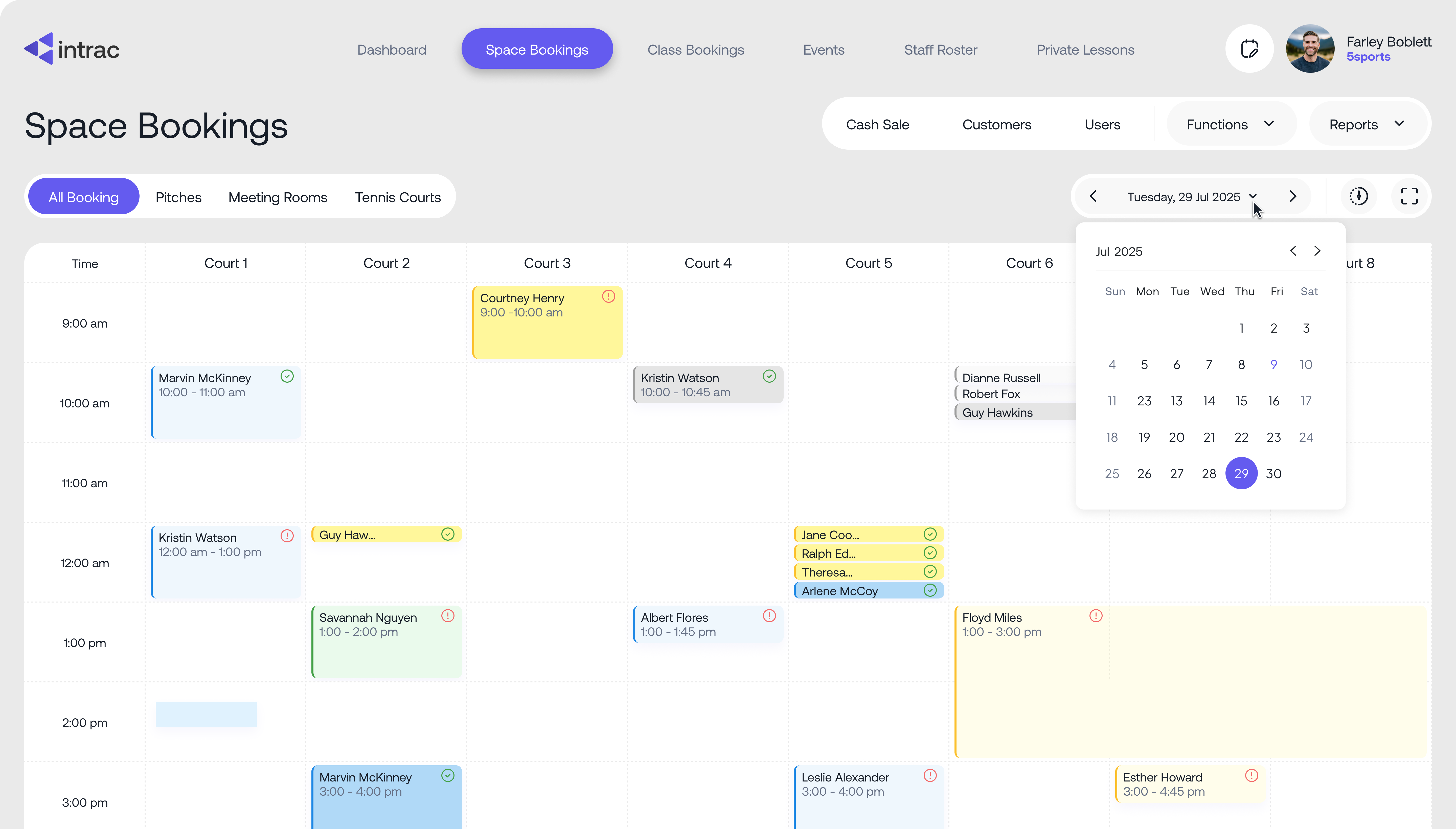
Intrac builds competition fixtures and draws, keeps ladders up to date as results come in, and applies weather credits when a round is lost.
Draws generated across courts and times, ladders updated from results.
Secure online payments, with weather credits for washed-out games.
No setup fees, local support, A+ security (OWASP).
How should ladder points and tie-breakers work?
Ladder points should reward wins clearly, give something for a draw, and treat forfeits consistently. Common systems are 3 for a win, 1 for a draw and 0 for a loss, or 4, 2 and 0. Whatever the choice, publish it with the draw before round 1.
None of these are fixed rules. Each sport's association, and often each venue, sets its own. Some social competitions add a point for every game played, to reward turning up, which keeps lower teams engaged but compresses the ladder. Junior competitions for younger age groups often keep no ladder at all and record results only for grading. The only wrong choice is changing the system mid-season.
Forfeits need their own line in the rules. A common approach is that the team that turns up receives the points for a win and a set score, such as 5-0 in futsal, while the forfeiting team receives no points. Some competitions deduct a point for a forfeit or fine the team, particularly for late forfeits that leave a court and a referee paid for and empty. Decide whether the set score counts towards for and against, because it will affect tie-breakers.
Byes rarely need points in a single round robin, because every team gets the same number of byes by the end. The ladder only looks uneven mid-season, when some teams have played one more game than others. Showing games played beside every team makes the difference obvious.
Tie-breakers settle teams level on points. The usual options, applied in a published order, are:
Goal or point difference. Scores for minus scores against. Common in football and futsal.
Percentage. Scores for divided by scores against, multiplied by 100. Common in netball, basketball and Australian rules competitions, because it scales better when scores are high.
Scores for. The team that scored more ranks higher, which rewards attacking play.
Head-to-head. The result of the match between the tied teams. Simple for two teams, messy for three, so most competitions list it after the score-based measures or use it only for two-way ties. A coin toss or a playoff is the last resort.
What happens with washouts, forfeits and rescheduling?
When a round is lost to rain, heat or a facility problem, the competition either replays it in a catch-up week, records it as a draw, or cancels it and adjusts the ladder. Pick the rule before the season starts and apply it the same way every time.
The cleanest fix is a buffer week. A ten-week term with a nine-round draw has one spare night, so a washout in week 4 pushes rounds 4 to 9 back one week and the season still ends on time. Without a buffer, the options narrow to recording the round as a draw with points shared, or cancelling it and ranking teams on average points per game.
Heat is a growing reason for postponements in outdoor and non-air-conditioned venues. Sports Medicine Australia's Extreme Heat Policy assesses risk from temperature, humidity, sun and wind together, and is intended for use by everyone from community officials and volunteers to elite sport (Sports Medicine Australia). Many state sporting associations reference it in their own extreme weather policies, so check what the relevant body expects before writing the venue's rule.
Money is the part teams ask about first. If team fees are charged per game, a cancelled round should produce a credit or a refund, and teams should be told which within a day. Credits that carry automatically to the next term are simpler to administer than refunds and keep teams entered. Whatever the policy, publish it in the competition terms so the conversation on a wet Tuesday is short.
Late withdrawals are the other common disruption. If a team pulls out before round 1, rebuild the draw with the new number. If it withdraws mid-season, the usual options are to void all its results, so every remaining team has played the same opponents, or to keep the results and award forfeits for the rest. Voiding is fairer to the ladder. Keeping results is kinder to teams that beat them early.
What are the next steps for fixturing your next season?
Start by counting teams and playable weeks, then choose single round robin, double round robin or pools and finals from the formulas. Write the competition rules, including points, tie-breakers, forfeits and washouts, before registrations open. Build the draw last.
Next, build the pairings with the circle method using numbers, assign home and away, and rotate timeslots and courts. Count every team's early games, late games, home games and byes before anyone sees the draw. One unbalanced count found now saves a dozen emails in week three.
Finally, decide whether the process should stay manual. A single six-team competition is a comfortable spreadsheet job. Several divisions across several nights usually are not, and that is when a system built for it pays off. Intrac, a class & facility management system for sports facilities, schools and academies, handles fixtures, draws, ladders and weather credits alongside court bookings and payments. Take a real competition list and book a demo to see the draw built from it.