Court and space hire pricing should have two or three clear tiers, peak, off-peak and member, set once and applied consistently, while scheduling needs to live in the same system as your coaching programs so casual hire can never double-book a court that's already committed to a clinic. Intrac handles both in one calendar, which is what actually prevents the clashes.
This is for tennis centres, multi-sport facilities and clubs that hire out courts or spaces alongside running their own programs, and who are either leaving off-peak hours empty or fielding complaints about double-booked courts. Below is how to structure pricing, avoid clashes, and get more use out of the hours nobody's booking.
Peak vs off-peak pricing structures
Most Australian venues price court hire in two or three bands: a peak rate for evenings and weekends, an off-peak rate for weekday daytime hours, and sometimes a shoulder rate in between. The specific dollar figure is yours to set based on your own costs and local market. What matters operationally is that the bands are few, clearly defined by day and hour, and published somewhere a casual hirer can check before they call.
Keep the number of bands small. Five different rates across the week looks sophisticated on a spreadsheet and confuses every casual hirer trying to book online. Two or three clear bands, consistently applied, book faster and generate fewer phone calls asking "which rate am I on?"
- Define peak and off-peak by specific days and hours, not loosely by "evenings" or "weekends".
- Publish the rate table somewhere a casual hirer can see it before booking.
- Keep the number of bands low enough that staff can quote them from memory.
- Two or three clear pricing bands beat five confusing ones.
- Define peak and off-peak by exact hours, not vague time-of-day terms.
- Publish rates before hirers book, not after they ask.
Member vs casual rate tiers
A member rate rewards loyalty and gives people a concrete reason to join rather than book casually every time. It also gives you a predictable revenue base. Members who've already committed are far more likely to use their allocated hours than a casual hirer is to show up for an unpaid booking.
The member discount doesn't need to be large to work. What matters is that it's clearly communicated at the point a casual hirer books, so they can see exactly what they'd save by joining. That single comparison does more to convert casual hirers into members than any separate marketing campaign.
Block bookings and season passes
Clubs and regular groups want certainty: the same court, the same time, every week, for a season. Block bookings and season passes give them that certainty while giving you guaranteed utilisation for that slot without having to resell it week after week.
The trade-off is flexibility. A block booking holder who stops showing up still occupies the slot unless your terms allow you to release unused sessions back into casual availability. Build that release clause into the season pass terms from the start, rather than discovering the gap when a court sits empty despite being "booked".

Avoiding double-bookings
Double-bookings almost always happen when coaching programs and casual hire are managed in two separate systems, or one system and one whiteboard. A coach blocks out a court for a clinic in one calendar; a casual hirer books the same court online through a different booking page. Nobody notices until both parties arrive.
The only reliable fix is a single shared calendar that every booking type draws from: coaching, casual hire, block bookings and maintenance all sitting on the same court timeline, so a clash is physically impossible rather than something staff have to remember to check for.
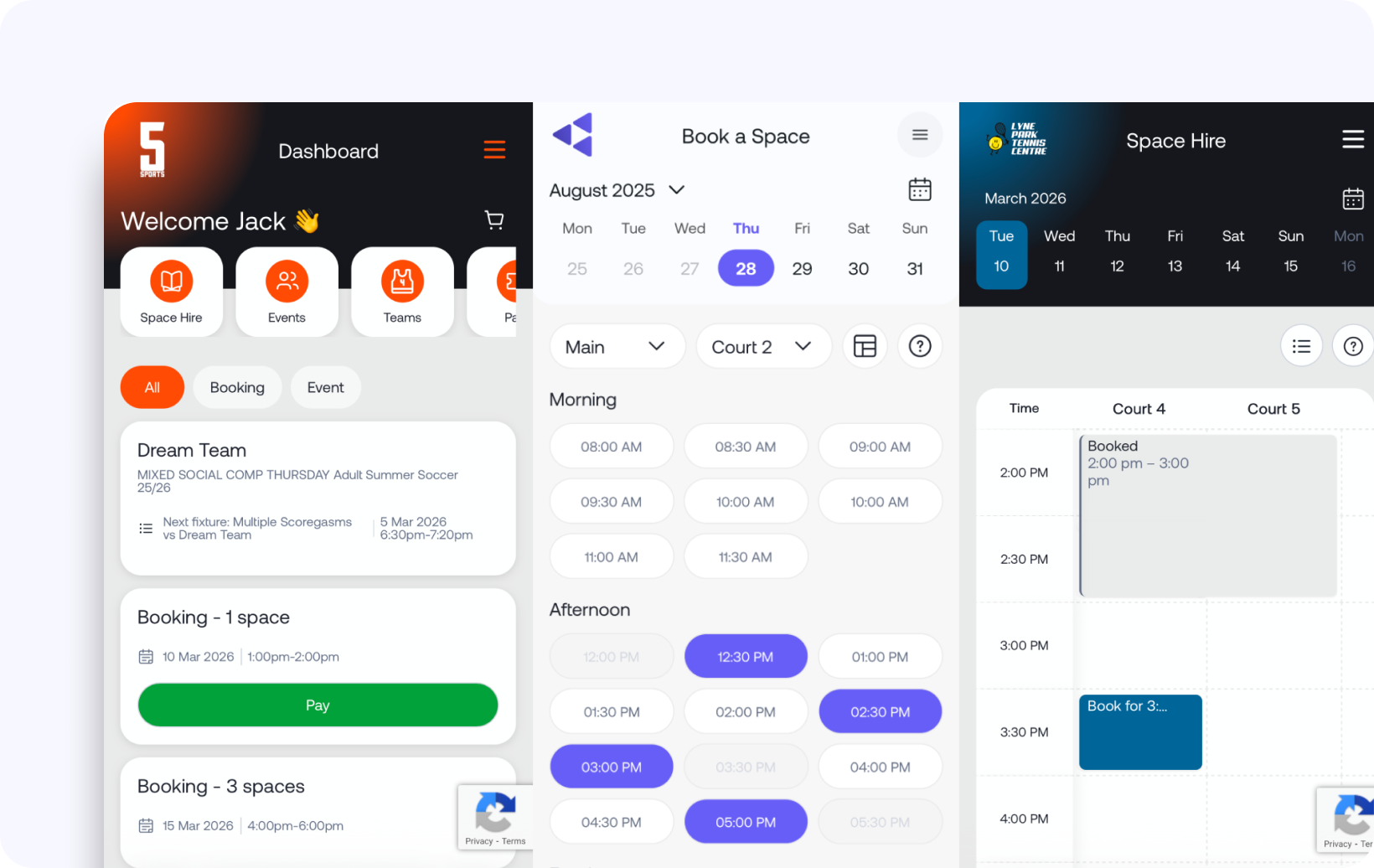
Intrac's space bookings screen and court timeline show every booking type against the same courts, so a casual hire request simply can't be confirmed against a court that's already allocated to a program.
Lifting off-peak utilisation
Off-peak hours are empty for a reason: most casual hirers want evenings and weekends. Rather than hoping demand shifts, target the off-peak slot at an audience that's actually free then: retirees, parents with toddlers during school hours, or corporate groups looking for a midweek social hit.
A lower off-peak rate helps, but a rate alone rarely fills a slot nobody knows exists. Promote specific off-peak packages, a midweek social comp, a toddler-friendly hire window, rather than just discounting the same generic booking.
Before discounting an off-peak slot further, check who's actually asking about it and been turned away by the timing. A slightly later start time sometimes unlocks the audience you already have without touching the price at all.
Scheduling around maintenance downtime
Maintenance that isn't on the booking calendar gets double-booked just as easily as a coaching clinic. Resurfacing, net repairs, or a routine inspection need to block that court in the same system casual hirers and coaches are booking from, not a separate facilities spreadsheet nobody else sees.
Scheduling maintenance in off-peak windows, well ahead of time, protects your highest-revenue hours from being the ones that get bumped when a repair runs long.
Give maintenance the same lead time you'd expect from a block booking holder. A net replacement or resurfacing job booked three weeks out can be slotted into a quiet weekday morning with plenty of notice to hirers; the same job discovered the week it needs doing usually ends up eating into a Saturday evening because that's the only gap left on the calendar. Plan maintenance like a booking, not an interruption to one.

A court that's booked, maintained and coached from one calendar is a court that never gets double-booked by accident. Intrac keeps all three on the same timeline so nothing falls through the gap between systems.
Intrac's customer app lets hirers book a space from a live court timeline that already reflects every class, clinic and maintenance block.
Coaching, casual hire and maintenance all sit on the same calendar, so clashes can't happen.
Hirers book and pay for a space directly in the customer app.
Peak, off-peak and member pricing apply automatically based on the booking.
Finding your underperforming courts
You can't fix an underused court or timeslot you haven't identified. Reporting on bookings by court and by hour shows exactly where the gaps sit. Often it's one specific court, at one specific time, rather than a whole-facility problem.
Once you know which court and which hour is underperforming, the fix is usually one of the levers already covered here: a different rate, a block booking offer, a repositioned off-peak package, or simply confirming it isn't being blocked out by a clash nobody noticed.
It's worth separating a genuinely low-demand slot from one that's merely mispriced or mistimed. A very early weekday court that's rarely booked might simply be too early for your local market, in which case discounting won't fill it. But an evening slot sitting empty next to a fully booked slot on an adjacent night is usually a scheduling or promotion problem worth solving before it's written off as dead time.
- Review bookings by court and hour each month, not just total revenue.
- Target specific underused slots with a specific offer, not a blanket discount.
- Check for scheduling clashes before assuming a slot has genuinely low demand.
Super Kids Sports runs coaching programs and space bookings across three Manly locations on exactly this kind of shared scheduling. See their story in our Super Kids Sports customer story. Browse Intrac's full capability set on the features page, see pricing on our plans, or book a demo to see your own courts on one calendar.