
Facility management software cost is the total amount a sports facility, swim school or academy pays to run its bookings, enrolments, payments and reporting through one system. That includes the monthly subscription, and it also includes payment processing, setup, add-on modules, SMS, hardware and whatever the contract charges to leave. Most operators only compare the first of those numbers.
This guide sets out how Australian providers price class booking, swim school and facility management software, which costs sit outside the headline fee, and how to compare quotes on a like-for-like basis. It finishes with an illustrative worked example for a swim school, so the pricing models can be compared side by side with real-looking numbers.
- How much does facility management software cost in Australia?
- What pricing models do booking software providers use?
- What costs sit outside the monthly subscription?
- How do you work out the total cost of ownership?
- What would each pricing model cost a swim school?
- How do you compare software quotes fairly?
- What are the next steps before signing a software quote?
How much does facility management software cost in Australia?
For an established Australian swim school, tennis centre or multi-sport facility, software usually costs from a few hundred to a few thousand dollars a month, plus GST. Where a facility lands depends on its size, revenue, number of locations and the pricing model.
The range is wide because providers charge for different things. One quote is based on active students, another on monthly revenue, another on a flat tier with modules added on top. A small dance or music school with a single studio sits at the bottom of the range. A multi-court tennis centre or a swim school with several pools, a busy front desk and hundreds of weekly lessons sits much higher.
The headline monthly fee is also only part of the bill. Card and direct debit processing, setup and data migration, staff training, SMS messages, EFTPOS terminals and access control hardware are often priced separately. Contract length and exit fees decide what it costs if the system does not work out. Two quotes with the same monthly fee can differ by thousands of dollars over two years once those lines are added.
The useful question for any operator is narrower than the title of this guide: what will this particular facility pay, all in, over the life of the contract? The rest of this article is about answering that.
The software fee for an established facility usually runs from a few hundred to a few thousand dollars a month, plus GST.
Payment processing, setup, SMS, hardware and contract terms can add as much as the subscription itself.
Compare quotes on total cost over 24 to 36 months, using your own student numbers and revenue.
What pricing models do booking software providers use?
Australian booking software is usually priced per member or student, by flat monthly tier, as a percentage of revenue, or as a low base fee plus booking fees paid by customers. Many providers combine two of these.
Per member or per student. The facility pays a set amount for each active member, student or enrolled child each month. It is simple to understand and scales with headcount. The catch is the definition of active. A family with three children, a student on a holiday break or a member on suspension may each count differently, so ask for the exact rule in writing.
Flat monthly tiers. A fixed fee covers a band, such as up to a set number of students, users or locations. Budgeting is easy while the facility stays inside the band. Crossing into the next tier causes a step jump, and core features such as online enrolment, a parent portal or point of sale are sometimes sold as extra modules on top of the tier.
Percentage of revenue. The provider charges a percentage of the revenue processed through the system each month, usually with a monthly minimum. The fee rises in a strong month and falls in a quiet one, which suits seasonal businesses such as swim schools and outdoor tennis. The key questions are which revenue the rate applies to, what the minimum is and what the percentage includes.
Low base fee plus booking fees. The facility pays a small subscription and the provider adds a fee to each online booking or payment, paid by the customer. It looks cheap on the facility's statement, but parents and players carry the cost, and they notice it on every transaction.
Flat monthly tiers or a set price per member or student.
Easy to budget while numbers stay inside a tier.
Costs the same in a quiet month as in a busy one.
Jumps in steps when you cross a tier or add a module.
A percentage of revenue or a fee on each booking.
Rises and falls with what the facility actually earns.
Lower in a winter dip or a term break.
Needs a clear view of what revenue the rate applies to.
No model is cheapest in every situation. Per-student pricing suits a facility with high revenue per student. Percentage pricing suits a facility whose revenue swings with the seasons or that is still growing into its timetable. Flat tiers suit a facility that sits comfortably in the middle of a band and expects to stay there. The only way to know is to run the numbers for your own facility.

What costs sit outside the monthly subscription?
Payment processing, setup and migration, training, SMS, hardware and contract exit costs usually sit outside the monthly subscription. Together they can match or exceed the software fee, so every quote should list them as separate lines.
Payment processing. Every card payment, EFTPOS transaction and direct debit carries a processing cost from the payment provider. Some software includes processing in its fee, others pass it through at a separate rate, and some require you to use their own payment provider. Failed direct debits can carry a dishonour fee on top. Ask for the rate on each payment type, who sets it, and whether you can bring your own merchant facility.
Booking fees and surcharges. Passing costs to customers has become harder. The Reserve Bank concluded that card surcharging on eftpos, Mastercard and Visa debit and credit cards should end on 1 October 2026 (Reserve Bank of Australia). The ACCC notes that relabelling a card surcharge as another kind of fee may be misleading (ACCC). Any software model that relies on adding fees to customer payments deserves a careful look.
Setup, migration and training. Some providers charge a one-off fee to configure the system, import customer and class data from the old one, and train staff. Ask whether migration covers payment details for direct debit customers, historical attendance and account balances, because re-entering those by hand is slow and error-prone.
SMS and email. Class reminders, cancellation notices and failed payment alerts are often sent by SMS, and SMS is commonly charged per message or in bundles. A busy swim school can send thousands of messages a month, so estimate your real volume before comparing.
Hardware. EFTPOS terminals are usually rented or bought from a payment provider. Access control and court lighting need controllers, gates or door hardware and an installer. Check-in kiosks and receipt printers add more. Ask which hardware the software works with, so you are not forced to replace equipment that still works.
Contract terms. Minimum terms of 12, 24 or 36 months are common in software contracts. Read the early termination clause, the notice period, any automatic renewal and any annual price increase clause. Also ask how you export your customer, booking and payment data if you leave, and whether that costs extra.
Ask every provider the same question in writing: what will we pay in month one, month twelve and month twenty-four, and what will it cost to leave? A provider who answers all four plainly is usually one you can budget around.
How do you work out the total cost of ownership?
Total cost of ownership is every amount the facility will pay for the system over a set period, usually 24 to 36 months, plus the staff time it saves or costs. Divide that total by the number of months to get a true monthly figure.
A workable formula has four parts. One-off costs: setup, migration, training and hardware purchases. Recurring software costs: subscription, modules, extra locations, extra staff logins and SMS. Payment costs: processing on each payment type, dishonour fees and terminal rental. Exit costs: any early termination fee and data export charge, which count even if you never expect to leave.

The cheapest quote on day one is often the dearest by month thirty. Setup fees, add-on modules and lock-in terms are easy to miss in a demo and hard to undo once the contract is signed. A simple total cost sheet, filled in the same way for every provider, protects the budget for years.
Staff time is the part most cost sheets leave out. If the front desk spends five hours a week chasing failed payments, matching EFTPOS takings to bookings or re-entering enrolments, that time has a cost. As an illustration, five hours a week at $35 an hour including on-costs is about $760 a month, enough to change which quote is cheapest. Software that automates reminders, rolls and reconciliation is worth more than its fee suggests.
Growth matters as well. A facility planning a new pool, more courts or a second site should price each quote at today's size and at the size it expects in two years. Per-student and tiered models step up as numbers grow, and percentage models rise with revenue, so the order of the quotes can change. The daily routine for checking payments against bookings, covered in how to reconcile booking payments daily, is a good test of how much manual work each system leaves behind.
What would each pricing model cost a swim school?
In this illustrative example, four quotes for the same swim school land within about $100 a month of each other once every cost is added, despite headline fees from $249 to over $1,500.
The facility is hypothetical. The numbers are illustrative and do not represent any specific provider's pricing. Picture a single-site swim school with 600 active students, about $52,000 a month in lesson fees, monthly direct debit billing, two front desk terminals and around 2,000 SMS reminders a month. Processing costs are left out because they are assumed to be similar across all four quotes, which is something to confirm in practice. All figures are monthly, before GST.
Quote A, per student. $2.20 per active student is $1,320, plus SMS at 6 cents a message is $120, for $1,440 a month. Add a $2,500 setup and migration fee. Over 24 months that is $37,060, or about $1,544 a month.
Quote B, flat tier. The tier for up to 750 students is $1,050, plus $150 for the online enrolment module and $80 for an SMS bundle, for $1,280 a month. Add a $4,000 setup fee and a 24-month minimum term. Over 24 months that is $34,720, or about $1,447 a month, provided the school does not leave early.
Quote C, low base plus booking fees. The subscription is $249 plus $120 of SMS, so the school pays $369 a month. Parents pay a $1.95 fee on each online payment. At 600 monthly payments that is $1,170 a month carried by families, and the combined cost is about $1,539 a month. The school's statement looks small, but every family sees an extra charge on every payment.
Quote D, percentage of revenue. At 2.95% of $52,000 the fee is $1,534 a month, with no setup fee and no lock-in. Over 24 months that is $36,816, or $1,534 a month. In a winter month when revenue drops to $40,000 the fee falls to $1,180. In a strong summer month at $60,000 it rises to $1,770.
The lesson is that headline prices differ far more than totals. Quote B looks cheapest over two years, but only if nothing changes, and it carries the most risk if the school outgrows the tier or wants to leave. Quote C looks cheapest on the school's own statement and is in practice paid by parents. Quotes A and D track the business, one by headcount and one by revenue.
A tennis centre would see the same pattern with different drivers. Court hire and coaching revenue swing with weather and season, so a percentage model tends to flex with the business, while a per-member model depends on how social players, juniors and casual hirers are counted. Operators running pools can read how these systems handle term enrolments on the swim schools page.
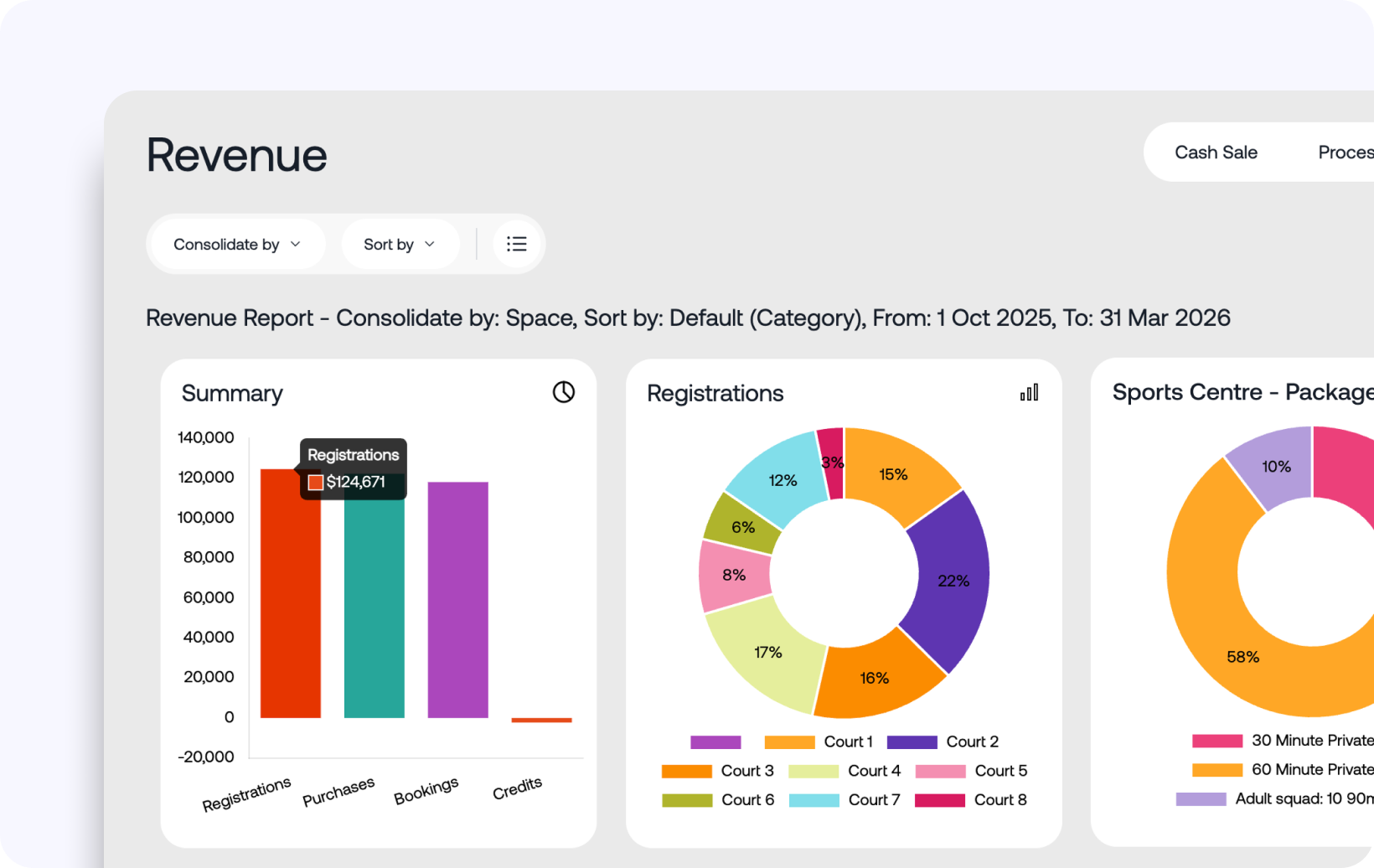
Intrac is a class & facility management system for sports facilities, schools and academies, priced as a percentage of monthly revenue: Basics 1.95% ($495 monthly minimum), Essentials 2.95% ($575) and Premium 3.95% ($785), plus GST.
The fee moves with what the facility earns, with a set monthly minimum per plan.
Australian support on 1300 468 000, with no setup fees to get started.
No exit fees to budget for. A+ security (OWASP).
How do you compare software quotes fairly?
Compare quotes fairly by sending every provider the same brief, asking for every cost in writing, totalling each over the same period and testing each against a quiet month and a growth scenario. Read the contract before the demo.
Most quote comparisons go wrong because each provider is answering a different question. One prices last month's student count, another prices a guess at next year's, and a third leaves out the modules you need. A one-page brief fixes this. It should list active students or members, monthly revenue, number of sites, payment types taken, expected SMS volume, hardware on hand and the features you cannot run without.
Give every provider your student or member count, monthly revenue, locations and must-have features.
Subscription, modules, setup, migration, training, SMS, hardware, processing and exit costs, in writing.
Total each quote over 24 to 36 months, then test it at a quiet month and at 20 per cent growth.
Confirm minimum term, notice period, price-rise clauses and how you get your data out.
Price is one part of the decision. Whether the system fits your programs, staff and families is the bigger part, and that is covered in our guide to choosing facility management software. Use the cost sheet to narrow the field, then let fit decide between the quotes that remain.
Watch for a few patterns. A low price that only applies for the first year. Features shown in the demo that sit in a higher tier. Processing locked to one provider at a rate that is not written down. A contract that renews automatically for another full term unless you give notice months ahead. Ask which card, EFTPOS and direct debit payment types are supported, and who processes each one.
Finally, ask for references from a facility like yours, of similar size and in the same sport. An operator who has been through a full year of billing on a system can tell you things no quote will.
What are the next steps before signing a software quote?
Before signing, write down your current all-in software cost, send one brief to every shortlisted provider, build a 24 to 36 month cost sheet and read each contract's term and exit clauses. Sign only once the cheapest realistic total and the best fit point to the same system.
Start with what you pay now. Add the current subscription, processing statements, SMS bills, terminal rental and an honest estimate of staff time spent on manual admin. That figure is the baseline every new quote has to beat, and it is usually higher than operators expect.
Next, run the numbers for a normal month, your quietest month and a month at 20 per cent growth. A quote that only works in one of those three is a risk. Then check the exit: minimum term, notice period, renewal and data export. A system with no lock-in has to keep earning your business, which is a useful protection on its own.
Finally, see the system running with your own data. Look at the pricing page of each shortlisted provider, then book a demo with your timetable, student numbers and cost sheet in hand, and ask each provider to walk through what you would pay in month one, month twelve and month twenty-four.