Level progression works when three things line up: explicit assessment criteria that don't depend on which teacher is on deck, progress shared with parents as it happens rather than at a single end-of-term moment, and a class placement system that actually moves kids into the right-sized group once they're ready. Intrac links all three, so a progression decision made on the pool deck shows up in the parent portal and the class roster at the same time.
This is for swim school owners and head coaches who want fewer "why hasn't my child moved up" conversations and a progression system that holds up to scrutiny, not just good intentions. Below is how progression frameworks actually work, how AUSTSWIM qualification fits in, and how to keep parents informed without a weekly phone call.
- Typical level frameworks used in Australia
- AUSTSWIM qualification and what it guarantees
- What "ready to progress" should actually mean
- Keeping parents informed, not guessing
- Handling a plateau without losing the family
- Linking level data to class placement
- Why this is a safety issue, not just a service one
Typical level frameworks used in Australia
Most Australian swim schools run a staged framework, starting with water familiarisation and basic safety for the youngest or least confident swimmers, moving through stroke development, and finishing in squad or survival-focused levels for competent swimmers. The exact number of levels and their names vary school to school, which is fine as long as the criteria to move between them are written down and used the same way by every teacher.
The framework itself matters less than the consistency of how it's applied. A school with eight finely graded levels and clear criteria will outperform a school with three loose levels and no documented standard, every time, because parents can see exactly where their child sits and what's next.
- Define each level by specific, observable skills, not a general sense of "confidence".
- Use the same criteria regardless of which teacher is running the lesson.
- Keep the framework documented somewhere parents can see it, not just in teachers' heads.
- Consistency of criteria matters more than the number of levels you use.
- Every level should be defined by observable skills, not teacher judgement alone.
- Parents should be able to see the framework, not just hear about it at assessment time.
AUSTSWIM qualification and what it guarantees
AUSTSWIM's Teacher of Swimming and Water Safety course sets a minimum entry bar: candidates must be at least 16 years old and able to swim at least 10 metres, before they can begin training as a teacher (source). That's a floor, not a ceiling. It establishes a baseline of water competence and age for anyone starting the qualification pathway.
Once qualified, AUSTSWIM teachers hold a Teacher Licence that must be renewed every three years, supported by ongoing professional development (source). That renewal cycle means the teaching standard behind your assessments is already maintained by a body outside your school, which is worth telling parents directly, since most have no idea the qualification is actively maintained rather than a one-off certificate.
What "ready to progress" should actually mean
"Ready to progress" should be a checklist a teacher can point to, not a feeling. If a level requires a child to swim a set distance unassisted, breathe bilaterally, and float unaided for a set time, write exactly that down. Then any teacher assessing any child applies the identical standard.
Avoid assessing on a single good day. A child who nails every skill once under ideal conditions but can't repeat it consistently isn't ready yet. The criteria should require a skill to be demonstrated reliably, not just achieved once while a teacher happened to be watching closely.

Keeping parents informed, not guessing
Most parent frustration with swim schools isn't actually about progression speed. It's about not knowing what's happening. A parent standing behind glass for twenty minutes a week has almost no visibility into what their child is being assessed on, which turns every "not ready yet" into a surprise rather than an expected update.
Learn to Swim Vic shares assessments directly from the pool deck, so parents see progress as it's recorded rather than waiting for a term-end report (see our Learn to Swim Vic customer story). That single change, visibility at the moment of assessment, does more to prevent disputes than any amount of extra explanation after the fact.
When a child isn't progressing, tell the parent what specific skill is missing, not just that they're "not ready yet". A concrete skill gap gives the family something to practise and a clear sign of what to look for next.
Handling a plateau without losing the family
Every swim school has children who plateau at a level for longer than their peers. Handled well, this is a normal part of learning a physical skill. Handled badly, with vague feedback, inconsistent assessment and a sense that other children are moving faster for no clear reason, it's one of the most common reasons families quietly leave.
Holding a child back should always come with a specific explanation and a specific plan: the exact skill still missing, and what the next few lessons will focus on to close that gap. Families rarely object to being told their child needs more time. They object to being told nothing at all.

A family that understands exactly why their child hasn't progressed yet is far more likely to stay enrolled than one left to guess. Intrac makes that explanation visible in the parent portal, in the teacher's own words.
Intrac lets teachers record assessments as they happen and shares them straight to the parent portal, with class placement updated automatically.
Teachers record skill checkpoints during the lesson, not from memory afterwards.
Progress appears in the parent portal as soon as it's recorded.
A completed level feeds directly into class scheduling for the next placement.
Linking level data to class placement
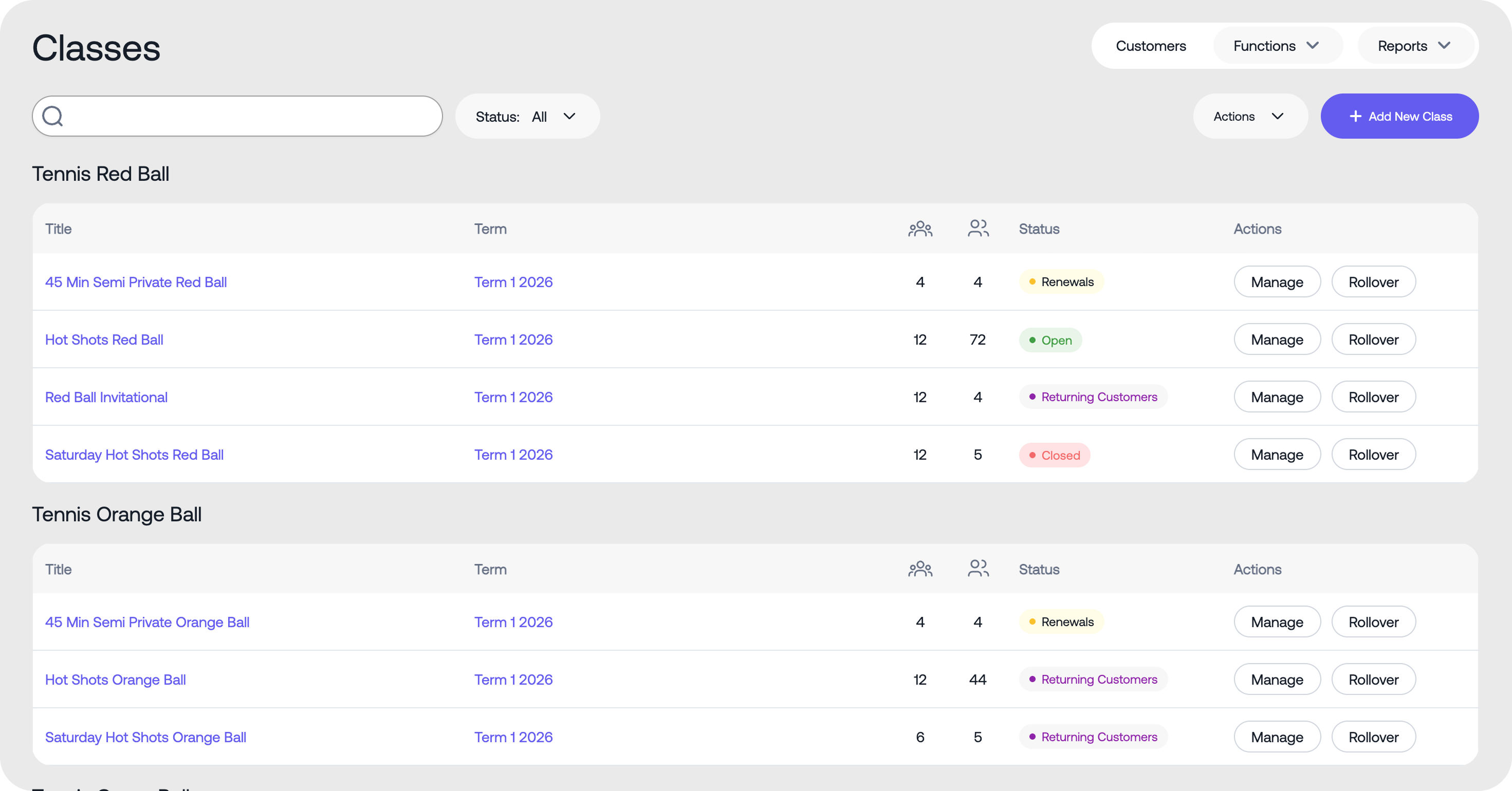
Progression data is only useful if it actually changes where a child sits in the timetable. A level system that's tracked on paper but doesn't automatically inform class placement just creates mixed-ability classes, where the most confident swimmers get bored and the least confident fall further behind.
Linking assessment outcomes directly to class scheduling means a child who's ready to progress moves into the right-sized group at the next available opportunity, rather than waiting for someone to manually cross-check a spreadsheet against the class list.
Why this is a safety issue, not just a service one
Accurate level progression isn't only about keeping families happy. A child placed above their actual ability is a genuine safety risk in and around water, which is exactly why the assessment criteria need to be rigorous and consistently applied rather than softened to keep a family happy or move a class along.
This is also where your teachers' AUSTSWIM qualification matters most: a Teacher Licence renewed every three years with ongoing professional development means the person making that safety call is maintaining a current, externally verified standard, not relying on experience alone (source).
- Never progress a child on a single good attempt. Require consistent demonstration of the skill.
- Document the specific reason for every progression decision, especially when holding a child back.
- Keep teacher qualifications current and visible to families as a safety credential, not just a compliance box.
- Make sure level data actually changes class placement, not just a report nobody reads.
If your progression process relies on a teacher's memory and a parent's patience, it's worth seeing how Learn to Swim Vic runs assessments from deck to portal in their customer story, or explore the full picture on Intrac for your industry. Book a demo to see assessments and the parent portal working together on your own levels.